Top Dating App Developers in 2026: A Complete Guide
Explore the leading dating app development companies, essential features, technology choices, and costs to plan a successful dating platform in 2026.
Top Dating App Developers in 2026: A Complete Guide
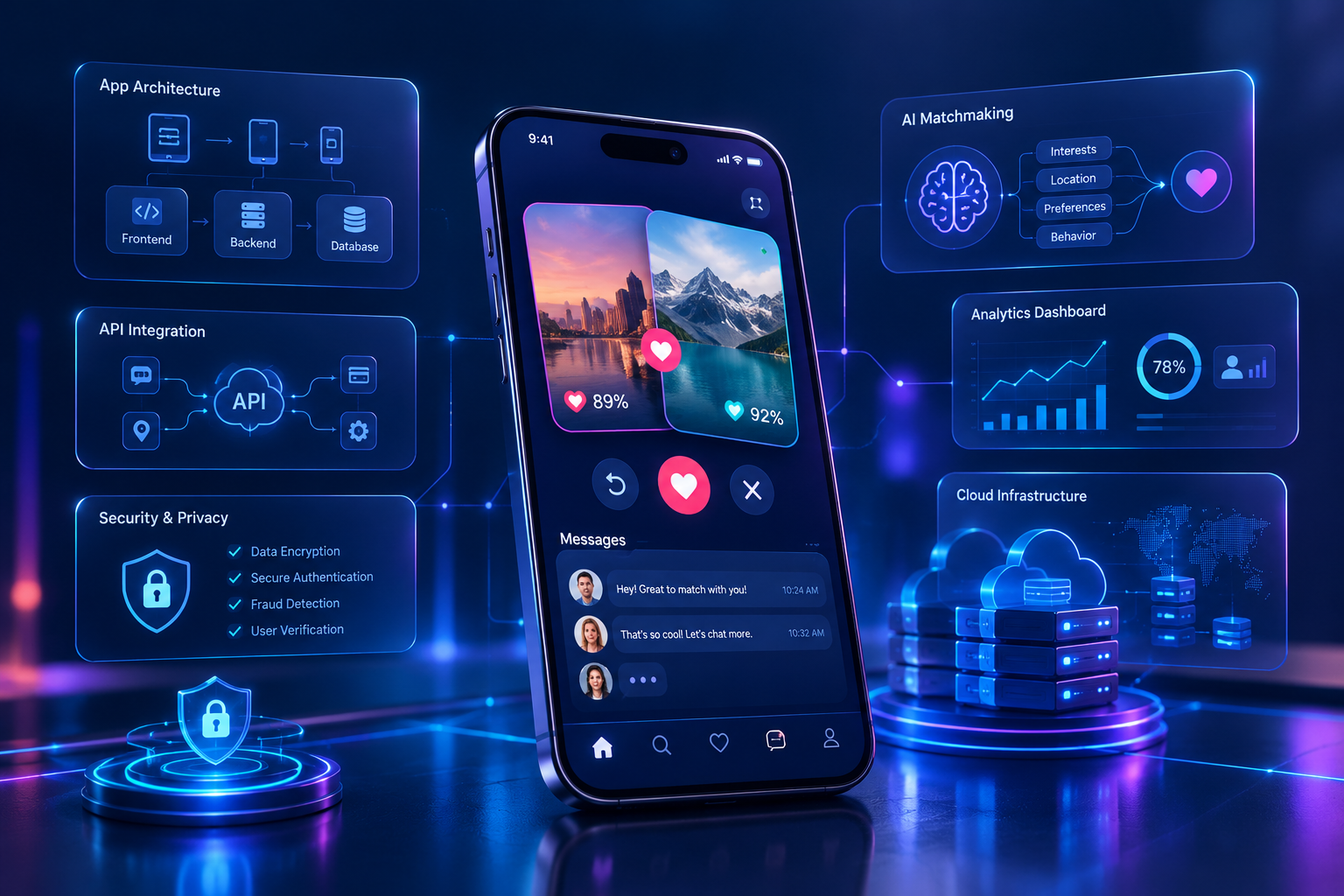
Building a successful dating app requires more than an attractive interface and a swipe-based matching system. Businesses need reliable mobile applications, intelligent matchmaking, real-time messaging, privacy controls, user verification, and scalable infrastructure to create a platform that people want to use.
Choosing among the top dating app developers in 2026 can be challenging because development agencies differ in technical expertise, pricing, project experience, communication, and ongoing support. Some specialize in startup MVPs, while others focus on enterprise applications, AI-powered recommendations, or complex social platforms.
This guide explores development companies worth evaluating, the capabilities to look for, typical project costs, essential features, and the questions to ask before signing a development agreement. It also explains how businesses can approach dating app development strategically, whether they are launching a new platform or upgrading an existing product.
If you are exploring the broader mobile app market, you can also read our guide to choosing a mobile app development company in Qatar.
What Is a Dating App Development Company?
A dating app development company designs, builds, tests, and maintains digital platforms that help people discover potential matches and communicate online.
Depending on the project, its services may include:
Product research and business strategy.
User experience (UX) and interface design.
iOS and Android application development.
User registration and profile management.
Matching and recommendation algorithms.
Real-time messaging and notifications.
Location-based discovery.
Identity and profile verification integrations.
Reporting, blocking, and content moderation.
Backend development, cloud infrastructure, and maintenance.
A capable development partner should understand both the technical requirements and the operational challenges of dating platforms. In particular, safety, privacy, user retention, and the quality of matches must be considered from the beginning.
Top Dating App Developers in 2026: Companies to Consider
The following companies provide starting points for researching potential development partners. This is an editorial shortlist, not a definitive ranking based on independently audited project outcomes. Services, portfolios, team availability, and commercial terms can change, so verify each company's current capabilities before making a decision.
1. Apptunix — Dating and Social Application Development
Apptunix is one company to evaluate when researching agencies that market dating app development and social application services.
A potential client should examine its relevant portfolio, including whether the team has delivered production applications with matching, messaging, subscriptions, and moderation features.
What to evaluate:
Experience with dating and social discovery products.
Custom matchmaking and recommendation capabilities.
Mobile application and backend expertise.
Post-launch maintenance and scalability.
Evidence of completed projects relevant to your business model.
Best suited for: Businesses looking for an agency with a dating and social application development offering.
2. JPLoft — Startup and Custom Mobile Applications
JPLoft is another company to consider when comparing custom mobile application development providers.
For a dating startup, the important question is whether the proposed team can turn an initial concept into a practical minimum viable product (MVP) without compromising essential security and safety features.
What to evaluate:
MVP planning and feature prioritization.
UI/UX design and mobile engineering.
Matching, messaging, and payment integrations.
Development milestones and testing procedures.
Relevant live applications or verifiable case studies.
Best suited for: Founders who want to validate a dating app concept before investing in a larger platform.
3. Guru TechnoLabs — Niche Dating Platforms
Guru TechnoLabs is worth researching for projects that require a tailored mobile product rather than a generic application template.
Niche dating platforms may serve communities with specific interests, cultural preferences, relationship goals, or compatibility requirements. These products often need specialized onboarding, profile filters, and matching logic.
What to evaluate:
Experience with niche matchmaking requirements.
Custom profile and search functionality.
Recommendation logic and integrations.
Administrative dashboards and moderation tools.
Flexibility to support future product changes.
Best suited for: Businesses targeting a clearly defined dating audience.
4. Trango Tech — Dating Applications and Engagement Features
Trango Tech is another candidate to investigate when comparing mobile development agencies offering dating and social application services.
Dating platforms depend on ongoing engagement, so the development partner should understand how to implement reliable communication, notifications, profile discovery, and analytics.
What to evaluate:
Relevant dating application references.
Real-time messaging architecture.
Subscription and in-app purchase integrations.
Performance under increasing user activity.
Analytics for measuring retention and engagement.
Best suited for: Businesses that want to develop a feature-rich application and measure how users interact with it.
5. RichestSoft — Custom and Ready-Made Dating Solutions
RichestSoft is worth considering if you are comparing custom development with ready-made or white-label dating software.
A white-label solution may provide a faster starting point, but it can introduce limitations involving customization, intellectual property, third-party dependencies, and long-term scalability.
What to evaluate:
The actual functionality included in the proposed package.
Whether the source code and intellectual property transfer to you.
Customization and integration limitations.
Security updates and ongoing support arrangements.
Total costs beyond the initial license or setup fee.
Best suited for: Businesses comparing faster template-based launches with fully customized applications.
6. Suffescom Solutions — Dating App Solutions and Templates
Suffescom Solutions is another potential provider to assess when researching dating app development and ready-made solutions.
Before choosing a template-based product, confirm whether it can support your planned user experience, moderation processes, payment model, and technical roadmap.
What to evaluate:
Available customization options.
Mobile platform compatibility.
Ownership and licensing terms.
Integration and upgrade costs.
Ability to support future feature development.
Best suited for: Entrepreneurs evaluating prebuilt dating software alongside custom development.
7. DevCom — Custom Software Engineering
DevCom is worth researching for projects where broader software engineering, system integration, and backend architecture are important considerations.
A dating application may require more than a mobile interface. It can also involve administrative portals, analytics systems, payment processing, identity verification, and customer support workflows.
What to evaluate:
Backend and API development capabilities.
System architecture and data management.
Security testing and quality assurance.
Technical documentation and maintainability.
Experience with consumer-facing mobile products.
Best suited for: Businesses with broader technical requirements beyond a basic dating app.
8. Expert App Devs — Mobile-First Application Development
Expert App Devs is another company to investigate when comparing mobile application development providers.
If your product depends on video introductions, live communication, or other media-intensive features, assess the team's ability to deliver these experiences reliably across supported devices and network conditions.
What to evaluate:
iOS and Android development expertise.
Video, audio, and real-time communication integrations.
Mobile performance and battery efficiency.
Testing across devices and operating systems.
Ongoing support and release management.
Best suited for: Businesses whose dating product relies heavily on mobile interaction or real-time communication.
9. Code Brew Labs — Custom Digital Products
Code Brew Labs is another potential provider to review when building a custom digital product.
Before engaging any agency, ask for examples that demonstrate relevant technical experience rather than relying solely on general claims about application development.
What to evaluate:
Experience with social platforms or consumer applications.
Product discovery and design processes.
Backend scalability and cloud infrastructure.
Data protection and operational support.
Communication practices and project reporting.
Best suited for: Businesses comparing agencies for a custom mobile product with a broader feature roadmap.
How to Compare These Dating App Developers
Company | Primary evaluation focus | Important question |
|---|---|---|
Apptunix | Dating and social applications | Can the team demonstrate relevant production work? |
JPLoft | Startup MVP development | Can it deliver a focused, testable first version? |
Guru TechnoLabs | Niche matchmaking | Can it implement specialized matching requirements? |
Trango Tech | Engagement features | How will messaging and retention be measured? |
RichestSoft | Custom versus white-label | What ownership and customization rights are included? |
Suffescom Solutions | Ready-made solutions | What are the template's limitations and ongoing costs? |
DevCom | Software engineering | Can it support complex backend requirements? |
Expert App Devs | Mobile and real-time features | Can it deliver reliable communication experiences? |
Code Brew Labs | Custom digital products | Can it demonstrate relevant product delivery experience? |
The best choice depends on your requirements, budget, target market, and the specific team assigned to the project. This comparison is a shortlist for further due diligence, not a claim that every provider has been independently verified against the same testing criteria.
Essential Features Every Dating App Should Consider
The right feature set depends on the intended audience and business model. However, most dating platforms need several core capabilities.
1. User Registration and Profile Management
Registration should be straightforward while providing appropriate safeguards against abuse.
Common capabilities include:
Email or phone verification.
Secure authentication.
Profile photographs and descriptions.
Interests and relationship preferences.
Profile editing and account deletion.
Privacy and visibility controls.
Collect only information necessary for the app's intended functionality. Sensitive information should not be exposed unnecessarily or shared with third parties without appropriate authorization.
2. Matching and Recommendation Systems
Matching is central to the dating experience. A basic implementation may filter profiles according to location, age preferences, and shared interests. More advanced systems may use compatibility questionnaires or recommendation models.
Useful capabilities include:
Preference-based filtering.
Mutual-interest matching.
Compatibility questions.
Relevance-based recommendations.
Controls for updating preferences.
Monitoring for unfair or unintended outcomes.
AI can help organize recommendations, but it should not be presented as a guarantee of relationship compatibility. Users should have meaningful control over their preferences and how recommendations are used.
3. Real-Time Messaging
Once two users match, reliable communication becomes essential.
A messaging system may include:
Text messages.
Image sharing with appropriate safeguards.
Message delivery indicators.
Push notifications.
Unmatching and blocking.
Reporting suspicious messages.
Rate limits to reduce spam and abuse.
Voice and video communication can be added when they support the product's objectives and budget.
4. Location-Based Discovery
Location-based features can help users discover potential matches within a selected area.
However, precise location data can create privacy risks. Consider using approximate distances, limiting location retention, and allowing users to manage location permissions.
The application should not reveal a user's exact whereabouts without a clear need and appropriate consent.
5. Profile Verification and User Safety
Safety is a core product requirement, not an optional extra.
Consider implementing:
Email or phone verification.
Optional photo or identity verification through appropriate providers.
Reporting and blocking controls.
Suspicious-account detection.
Moderation queues and administrative review.
Clear community standards.
Processes for responding to safety complaints.
Verification does not guarantee that an account is genuine or that a person is trustworthy. A responsible platform combines verification with reporting, moderation, and ongoing monitoring.
6. Subscription and Monetization Features
Dating apps may generate revenue through several models:
Monthly or annual subscriptions.
Premium discovery filters.
Optional profile boosts.
Paid virtual features, where appropriate.
Advertising, subject to privacy and platform policies.
The monetization model should be selected before development because it affects account management, payment integration, pricing screens, and reporting.
Technology Stack for Dating App Development
A dating application typically requires a mobile frontend, backend services, a database, communication infrastructure, and security controls.
Component | Common options | Purpose |
|---|---|---|
iOS development | Swift, SwiftUI | Native Apple platform experience |
Android development | Kotlin | Native Android experience |
Cross-platform development | Flutter, React Native | Shared application code across platforms |
Backend | Node.js, Python, Java | Business logic, matching, and APIs |
Database | PostgreSQL, other suitable databases | User profiles and structured records |
Real-time communication | WebSockets and managed messaging services | Live messaging and presence |
Cloud infrastructure | AWS, Microsoft Azure, Google Cloud | Hosting, scaling, and monitoring |
Analytics | Privacy-conscious analytics tools | Measuring product usage and retention |
These are examples rather than a mandatory stack. The appropriate technologies depend on the expected traffic, development team's expertise, integrations, and operational requirements.
Businesses considering cross-platform development can explore mobile application development services to understand the options available for custom mobile products.
How Much Does Dating App Development Cost in 2026?
Dating app development costs vary according to complexity, design, security requirements, integrations, and the experience of the development team.
The following figures are illustrative planning estimates in US dollars, not verified market averages or quotations from the companies listed above.
Project type | Illustrative budget | Typical scope |
|---|---|---|
Basic prototype | $5,000–$15,000 | Clickable screens and concept validation |
Focused MVP | $20,000–$50,000 | Profiles, basic matching, messaging, and essential administration |
Feature-rich application | $50,000–$120,000 | Advanced matching, subscriptions, moderation, and additional integrations |
Complex or enterprise platform | $120,000+ | Advanced architecture, extensive integrations, and higher operational requirements |
Actual quotations may fall outside these ranges. Taxes, third-party services, app store fees, and ongoing operations may be additional.
Factors That Affect Development Costs
Feature complexity: Video calling, sophisticated recommendation systems, and identity verification can require additional engineering.
Platform selection: Developing for both iOS and Android may cost more than launching on one platform, although cross-platform frameworks can reduce duplicated work.
Design requirements: Custom interfaces, accessibility testing, and extensive user research affect project effort.
Security and moderation: Account protection, reporting workflows, audit logs, and moderation tools require planning and ongoing maintenance.
Integrations: Payment providers, messaging services, analytics platforms, and verification vendors may charge recurring fees.
Maintenance: Operating system updates, bug fixes, infrastructure, security patches, and customer support continue after launch.
Request a breakdown of development, infrastructure, third-party fees, maintenance, and future enhancements instead of comparing proposals by headline price alone.
How to Choose the Right Dating App Development Company
1. Review Relevant Portfolio Evidence
Ask for examples of completed mobile applications with comparable functionality. Where possible, inspect live applications and confirm the agency's actual role in their development.
A portfolio containing attractive screenshots is not enough to establish production experience.
2. Evaluate Technical Expertise
The proposed team should explain how it will handle authentication, matching, messaging, data storage, security, and scaling.
Ask who will make architecture decisions and how technical risks will be managed.
3. Assess Privacy and Security Practices
Confirm how the provider handles personal information, access permissions, encryption, backups, vulnerability testing, and incident response.
For iOS distribution, review Apple's App Review Guidelines. Apple specifically addresses dating applications as an established category and says new submissions need a meaningfully different or improved experience. Its guidelines also address user-generated content, privacy disclosures, and account deletion.
An agency should understand these requirements, but no provider can guarantee app store approval.
4. Understand Ownership and Contract Terms
Your contract should clearly specify:
Source-code ownership and intellectual property rights.
Deliverables and milestone acceptance criteria.
Third-party licenses and recurring fees.
Confidentiality and data handling.
Warranty and maintenance arrangements.
Exit procedures and access to project documentation.
Clarify ownership of code, designs, databases, and any custom matching logic before work begins.
5. Compare Communication and Project Management
Ask who your main contact will be, how often progress reports will be provided, and how changes to scope will be approved.
A clear delivery process reduces misunderstandings and makes it easier to track progress.
6. Plan for Post-Launch Support
Launching the application is only one stage of the project. Your provider should explain how it will handle defects, security updates, platform changes, performance monitoring, and future releases.
You can review Galaxium Coding's software development services if you are comparing custom software approaches for a broader digital product.
Dating App Development for Businesses in Qatar
Businesses targeting Qatar or the wider Gulf region should evaluate local requirements as part of product planning rather than simply adapting a generic dating application.
Important considerations include:
Local legal review: Obtain qualified advice on applicable laws, data protection, consumer obligations, and the intended service model.
Privacy and cultural context: Design profile visibility, location controls, and communication settings around the needs of the intended audience.
Language support: Consider Arabic and English interfaces if both are relevant to the target market.
Payment compatibility: Evaluate suitable payment providers, currency presentation, subscription handling, and refunds.
Hosting and data transfers: Assess hosting locations, vendor access, and applicable data-transfer obligations.
Moderation: Establish clear community standards and practical processes for handling reports and harmful behavior.
Do not assume that a platform's availability, features, or legal suitability in one country will be identical in another. Obtain local advice before launch where regulatory or cultural questions affect the product.
Common Mistakes to Avoid
Copying an Existing Dating App Without Differentiation
A generic clone may be easy to describe but difficult to distinguish in a crowded market. Identify a specific audience, unmet need, or improved experience before investing in development.
Building Too Many Features at Once
Launching with every possible feature increases costs and delays validation. Start with the smallest product that can test your core assumptions safely.
Treating Safety as a Future Enhancement
Blocking, reporting, moderation, and account controls should be included in the initial product plan. Retrofitting them later may require significant redesign.
Ignoring User Acquisition
A technically successful application can still struggle if it cannot attract and retain users. Plan marketing, community development, launch geography, and initial user acquisition alongside engineering.
Choosing a Provider on Price Alone
A low initial quotation may exclude important integrations, testing, documentation, or maintenance. Compare complete project scopes and ownership terms.
Failing to Define Success Metrics
Track meaningful measures such as completed profiles, successful matches, conversations initiated, retention, user reports, and subscription conversion. Downloads alone do not demonstrate that a dating platform is delivering value.
Future Trends in Dating App Development
Several technology directions may influence dating products in the coming years.
AI-assisted recommendations: Recommendation systems may help users discover relevant profiles, provided that personalization is transparent and privacy-conscious.
Improved verification: Providers may introduce stronger verification workflows to reduce impersonation and improve confidence in profile authenticity.
More intentional matching: Apps may emphasize shared interests, relationship goals, and conversation quality rather than relying entirely on rapid swiping.
Privacy-focused design: Clear consent, data minimization, visibility controls, and account deletion are increasingly important design considerations.
Real-time experiences: Audio, video, and interactive communication may suit particular audiences, but should be introduced only when they provide genuine value.
These are possible development directions, not guarantees of future adoption. Product teams should test new features with real users before making large investments.
Final Thoughts
Choosing among the top dating app developers in 2026 requires a clear understanding of your audience, product goals, technical requirements, budget, and long-term operating model.
Companies such as Apptunix, JPLoft, Guru TechnoLabs, Trango Tech, RichestSoft, Suffescom Solutions, DevCom, Expert App Devs, and Code Brew Labs provide starting points for further research. However, the right partner is the one that can demonstrate relevant expertise, explain its approach clearly, protect your intellectual property, and support your application after launch.
Before signing a contract, compare proposals, review verifiable portfolio evidence, confirm security practices, and establish measurable delivery milestones.
If your business is planning a custom mobile product, contact Galaxium Coding to discuss your requirements and explore a suitable development approach.
Frequently Asked Questions
1. Who are the top dating app developers in 2026?
Companies worth researching include Apptunix, JPLoft, Guru TechnoLabs, Trango Tech, RichestSoft, Suffescom Solutions, DevCom, Expert App Devs, and Code Brew Labs. The best choice depends on relevant portfolio evidence, project scope, budget, and technical requirements.
2. How much does it cost to develop a dating app in 2026?
A basic prototype may cost approximately $5,000–$15,000, while a focused MVP may require $20,000–$50,000. Feature-rich or enterprise applications can cost considerably more. These are illustrative estimates, not confirmed market averages or vendor quotations.
3. How long does it take to develop a dating app?
A prototype may take several weeks, while a production-ready MVP may take several months. Complex applications can require substantially longer. The timeline depends on features, integrations, testing, team capacity, and approval processes.
4. What features should a dating app include?
Core features commonly include registration, profiles, preferences, matching, messaging, notifications, reporting, blocking, moderation, privacy controls, and account deletion. Additional features should be selected according to the product's audience and business model.
5. Should I build a custom dating app or use a white-label solution?
A white-label solution can provide a faster starting point, while custom development offers greater control over functionality, architecture, branding, and future changes. Compare total costs, licensing, ownership, customization limits, and maintenance requirements before deciding.
6. Can AI improve dating app matching?
AI can help rank or recommend profiles using permitted information and relevant signals. However, recommendations require careful evaluation, privacy safeguards, and monitoring for unfair outcomes. AI cannot guarantee compatibility or relationship success.
7. How can I make my dating app safer?
Implement appropriate verification, blocking, reporting, moderation, secure authentication, privacy controls, and clear community standards. Establish processes for reviewing reports and responding to safety incidents, and minimize the personal data you collect.
8. What should I ask a dating app development company before hiring it?
Ask about relevant live projects, the proposed technology stack, project milestones, security testing, source-code ownership, third-party costs, maintenance, team composition, and post-launch support. Request a written proposal with clearly defined deliverables.
9. Do dating apps need ongoing maintenance?
Yes. Applications need security patches, bug fixes, compatibility updates, infrastructure monitoring, and improvements based on user feedback. The maintenance plan and associated costs should be discussed before the initial build.
10. What makes a dating app different from a typical mobile application?
Dating applications combine personal profiles, discovery, matching, communication, trust and safety processes, and sensitive data management. They must also address user retention and the challenge of attracting enough relevant users to create meaningful connections.
11. Can a new dating app be approved by Apple's App Store?
Approval is not guaranteed. Apple's guidelines state that new dating apps must provide a meaningfully different or improved experience compared with established offerings. Review the current guidelines and plan differentiation, privacy, and safety requirements before submission.
12. How can I choose a dating app development company in Qatar?
Evaluate relevant project experience, mobile and backend capabilities, privacy practices, communication, ownership terms, and maintenance support. For a Qatar-focused launch, also seek qualified advice on local legal obligations, payment requirements, language needs, and data handling.