RAG vs Fine-Tuning: Which AI Approach Is Right for Your Business?
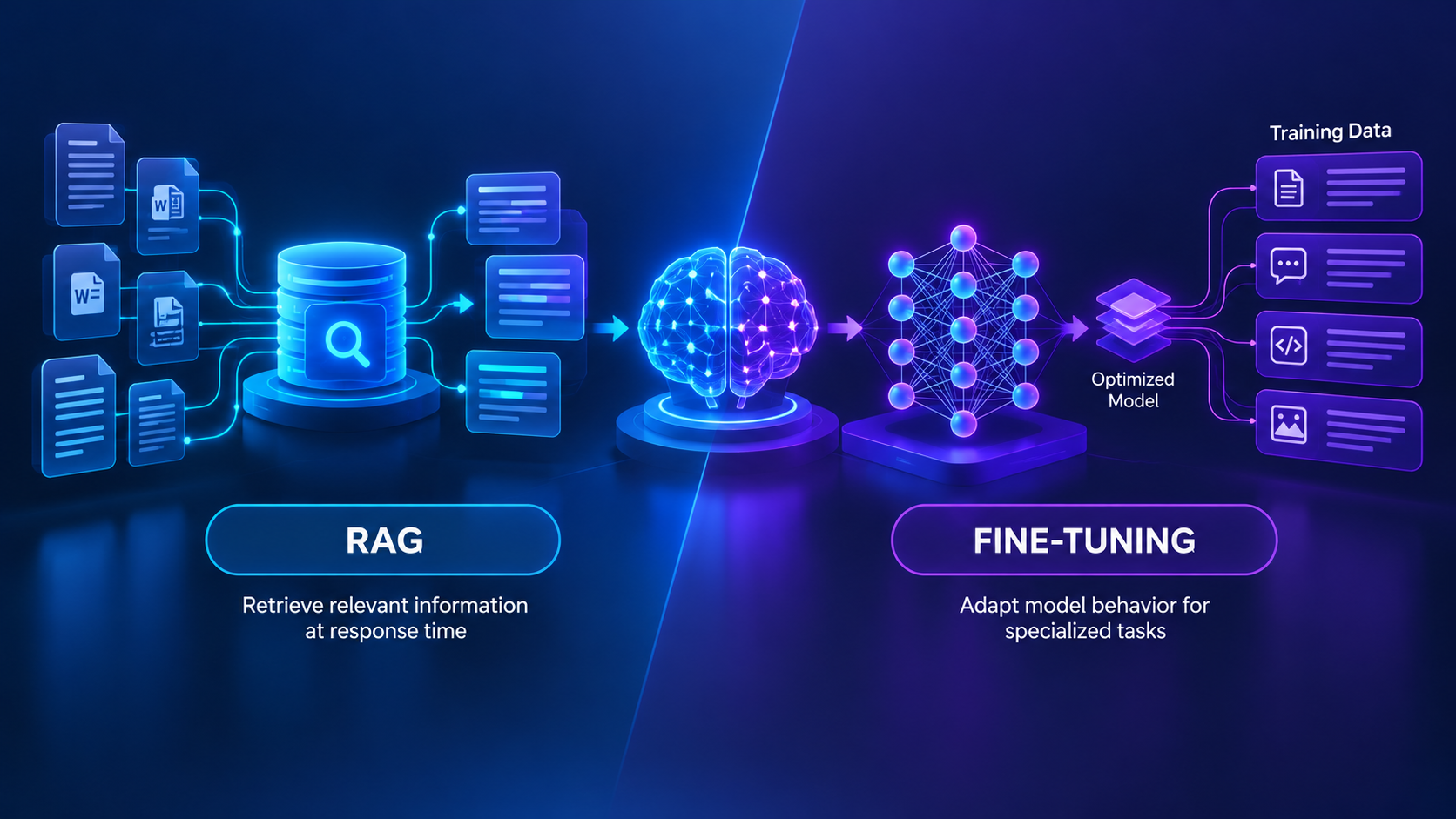
RAG retrieves relevant business information at response time, while fine-tuning adapts an AI model's behavior for specialized tasks.
RAG vs Fine-Tuning: Which AI Approach Is Right for Your Business?
Businesses adopting artificial intelligence often face an important technical decision: should they use Retrieval-Augmented Generation (RAG), fine-tune an AI model, or combine both approaches?
The answer depends on what the business needs its AI system to do. An AI assistant that answers questions using frequently updated company documents has different requirements from an AI application that must consistently follow a particular writing style, classify customer requests, or produce structured outputs.
RAG is generally a strong starting point when an AI system needs access to private, company-specific, or frequently changing information. Fine-tuning is worth considering when a model needs to learn a more consistent behavior, response format, task pattern, or domain-specific style. Some applications benefit from combining both.
Understanding the difference helps businesses avoid unnecessary development costs, select an appropriate AI architecture, and build systems that can evolve with their operations.
This guide compares RAG vs fine-tuning across functionality, implementation, maintenance, security, cost considerations, and real-world business applications. It also explains how companies in Qatar can evaluate these approaches when planning custom AI solutions.
What Is RAG in Artificial Intelligence?
Retrieval-Augmented Generation, commonly called RAG, is an AI architecture that retrieves relevant information from an external knowledge source and supplies it to a language model when answering a question.
Rather than depending exclusively on information learned during training, the model receives additional context from documents, databases, knowledge bases, or other approved information sources.
For example, imagine a company has an internal knowledge base containing employee policies, product manuals, service agreements, and operating procedures.
An employee asks:
"What is our process for approving a supplier invoice?"
A RAG-based application searches the company's approved documents, retrieves relevant passages, and provides them to the AI model. The model then generates an answer using that context.
How Does RAG Work?
A typical RAG workflow includes the following steps:
Collect information: Gather relevant documents, FAQs, manuals, and other approved sources.
Prepare the content: Extract text, remove unnecessary content, and divide documents into searchable sections.
Create an index: Represent information using embeddings, keyword indexes, or a combination of retrieval techniques.
Receive a question: The application processes the user's request.
Retrieve relevant information: A search system identifies passages that may answer the question.
Generate a response: The retrieved information is provided to the language model as context.
Present the answer: The application returns the response and, where supported, links or references to the source material.
A simplified architecture looks like this:
User question → Retrieval system → Relevant company information → AI model → Answer with supporting sources
The retrieval system can use vector search, traditional keyword search, metadata filtering, or hybrid search. The right approach depends on the content, terminology, query patterns, and accuracy requirements.
What Are the Main Benefits of RAG?
RAG can provide several practical advantages:
Access to current information: Approved documents can be updated without retraining the underlying model.
Company-specific answers: The application can reference internal information that was not part of the model's original training.
Source traceability: Retrieved passages can help the system provide references for users to verify.
Flexible knowledge management: Teams can add, replace, or remove documents through the retrieval pipeline.
Permission-aware access: Retrieval can be designed to respect user roles and document permissions.
Separation of knowledge and behavior: The company can maintain its knowledge base separately from the language model.
However, RAG does not automatically guarantee accurate answers. Poor retrieval, outdated documents, conflicting sources, incomplete context, and ambiguous questions can still produce incorrect responses.
The system must also be designed to handle cases where the available information does not support an answer.
What Is Fine-Tuning in AI?
Fine-tuning is a process in which an existing model is further trained on a curated dataset to adapt its behavior to a particular task or set of requirements.
The training examples can demonstrate the desired responses, classifications, formats, or task-specific patterns. Depending on the model and training method, fine-tuning adjusts model parameters to improve performance on the intended use case.
For example, a business may need an AI system that classifies customer messages into predefined categories:
Sales enquiry
Technical support
Billing question
Appointment request
Complaint
Escalation required
A carefully prepared training dataset can demonstrate how different messages should be classified, including examples involving informal language, spelling mistakes, or industry-specific terminology.
The goal is to make the model more consistent at the task rather than requiring the application to explain the same detailed behavioral instructions in every interaction.
How Does Fine-Tuning Work?
A typical fine-tuning project follows these steps:
Define the task: Identify the behavior that needs improvement.
Prepare training examples: Create representative input-and-output examples that demonstrate the desired behavior.
Validate data quality: Review examples for accuracy, consistency, privacy, and coverage of important edge cases.
Select a supported model and method: Confirm that the model provider supports the required fine-tuning approach.
Train the model: Run the fine-tuning process using the prepared dataset.
Evaluate performance: Compare the adapted model against the original model using representative test cases.
Deploy and monitor: Integrate the model into the application and monitor its results as requirements change.
Fine-tuning is not the same as uploading documents into a chatbot. It involves a training process, and its usefulness depends on the quality of the examples, the selected model, and the task being optimized.
What Are the Main Benefits of Fine-Tuning?
Fine-tuning can be useful when an application requires:
Consistent output structures, such as JSON fields or standardized reports.
Repeated classification or extraction tasks.
A particular tone, style, or response pattern.
Better performance on a specialized task when prompting alone is insufficient.
Reduced dependence on lengthy behavioral instructions in some supported configurations.
A more consistent approach to recurring workflows.
Fine-tuning also has limitations. Training data must be prepared and maintained, the model must be tested after changes, and new facts are not automatically incorporated simply because the model has been fine-tuned.
It should not be assumed that fine-tuning will reliably teach a model a large, changing collection of company facts. For that requirement, retrieval or another appropriate data-access mechanism is usually a better starting point.
RAG vs Fine-Tuning: Key Differences
Although both techniques can improve AI applications, they solve different problems.
Comparison factor | RAG | Fine-tuning |
|---|---|---|
Primary purpose | Supply relevant external information at response time | Adapt model behavior through additional training |
Company knowledge | Retrieves information from connected sources | Does not automatically provide access to a live knowledge base |
Updating information | Update the knowledge source and index | New training may be needed for behavioral changes |
Response behavior | Primarily influenced by the base model, instructions, and retrieved context | Can be influenced by patterns learned during fine-tuning |
Source references | Can return retrieved documents and citations | Does not inherently provide source citations |
Initial setup | Requires retrieval infrastructure and document preparation | Requires a suitable model, training examples, and training workflow |
Ongoing maintenance | Document quality, permissions, retrieval, and indexing | Dataset quality, model evaluation, retraining, and deployment |
Common use cases | Knowledge assistants, document search, policy questions | Classification, consistent formatting, specialized response patterns |
Main risk | Retrieving irrelevant or outdated information | Learning undesirable patterns or failing to generalize |
Best starting point | The application needs access to changing information | The application has a measurable behavior problem |
Neither approach is universally superior. The correct choice depends on the business requirement and the performance that must be improved.
RAG vs Fine-Tuning: Which Is Better for Your Business?
The most useful way to compare these approaches is to begin with the problem rather than the technology.
Choose RAG When Your AI Needs Business Knowledge
RAG is a strong candidate when the system must answer questions about information stored outside the model.
Examples include:
Employee handbooks and internal policies.
Product specifications and technical manuals.
Customer support documentation.
Contracts, approved procedures, and business documents.
Service catalogues and frequently changing product information.
Internal knowledge portals and searchable company archives.
Consider a company with 500 product documents. The company regularly changes prices, product features, availability, and support procedures.
A RAG system can retrieve relevant information from the approved source each time a user asks a question. When a document changes, the indexing pipeline can process the updated content without necessarily requiring another model training run.
The key requirement is reliable retrieval, appropriate access control, and a well-maintained source of truth.
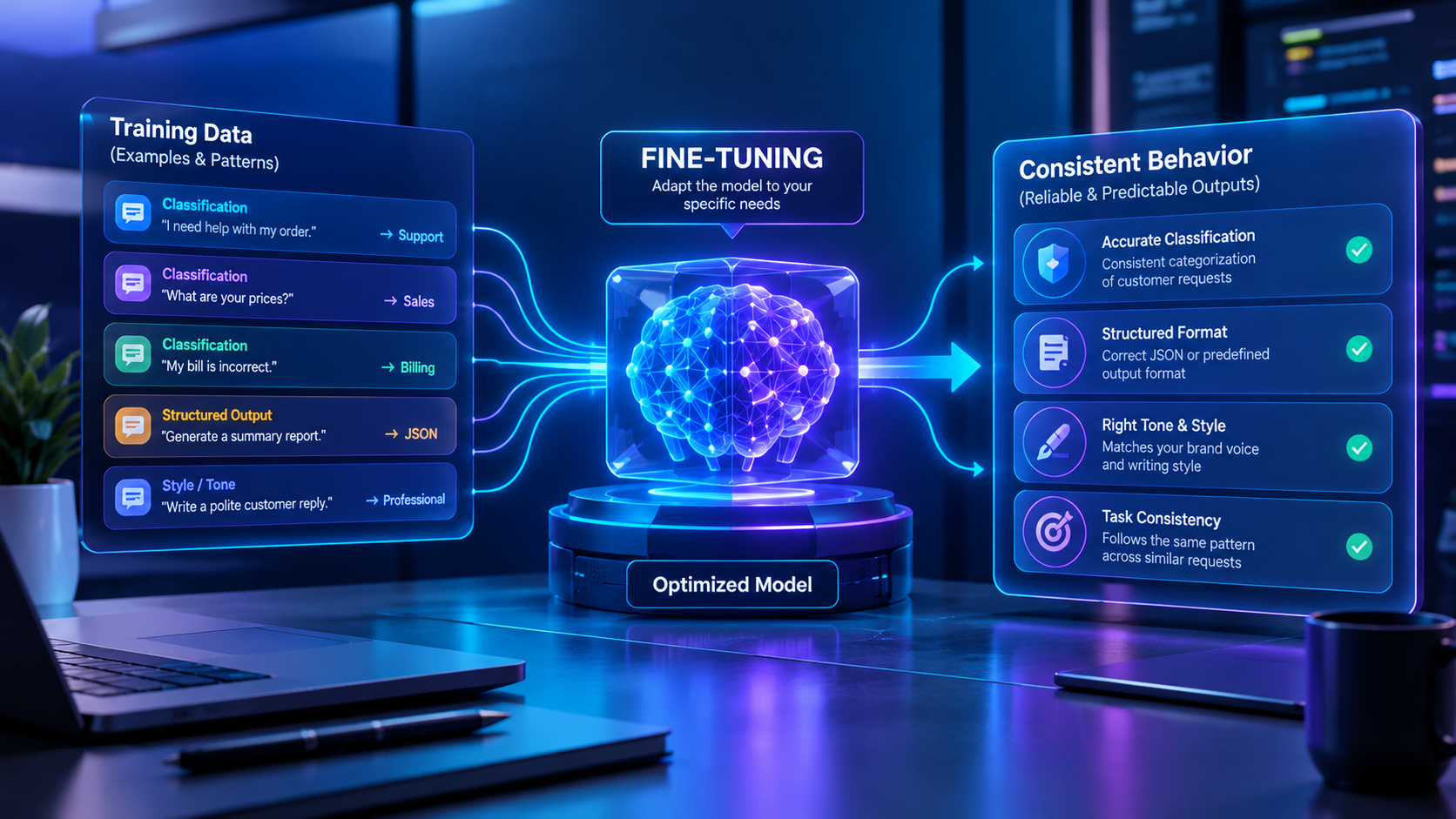
Choose Fine-Tuning When Your AI Needs Consistent Behavior
Fine-tuning may be appropriate when the challenge is how the model performs a task rather than where it obtains information.
Examples include:
Classifying customer support messages.
Producing consistently structured outputs.
Applying a specialized writing style.
Extracting information into a defined schema.
Following recurring task patterns.
Improving performance on a narrow, measurable task.
Imagine a customer service platform that must classify incoming messages according to a company's carefully defined support categories.
The company has a large, high-quality collection of representative examples. A fine-tuning experiment may help the model learn the distinctions between categories more consistently.
The team should still compare the fine-tuned model against a well-prompted baseline and measure performance on examples that were not used for training.
Choose Both When Your AI Needs Knowledge and Specialized Behavior
Some business applications need both access to company information and consistent task-specific behavior.
For example, a customer support assistant may need to:
Identify the customer's issue correctly.
Retrieve the applicable product documentation.
Generate a concise response in the company's approved style.
Include relevant source references.
Escalate sensitive or uncertain requests.
RAG can supply the relevant documentation. Fine-tuning may help with classification or response patterns if testing shows that additional training is worthwhile.
A combined architecture could look like this:
Customer message → Fine-tuned or otherwise task-optimized model → RAG retrieval → Response generation → Policy and quality checks → Customer
The exact sequence varies by application. Some systems retrieve information before generating a classification or answer, while others use separate models or processing stages.
The important principle is to assign each component a clear responsibility and evaluate whether it improves the overall system.
Practical Business Examples: RAG vs Fine-Tuning
Example 1: Employee Knowledge Assistant
A growing organization wants employees to ask questions about leave policies, onboarding, IT procedures, and internal approvals.
Recommended starting point: RAG.
The main challenge is accessing the correct information. A retrieval-based application can search approved documents and provide answers with references to relevant policies.
Fine-tuning is not usually the first requirement unless the organization also identifies a specific model behavior that needs improvement.
Example 2: Customer Support Classification
An online business receives thousands of customer messages and wants to categorize them consistently.
Recommended starting point: Evaluate prompting and structured outputs, then consider fine-tuning.
If the task is simple, a well-designed prompt and clear category definitions may be sufficient. If performance remains inadequate and a representative training dataset is available, fine-tuning may be worth testing.
RAG may be added if classification depends on product-specific or customer-specific information.
Example 3: Product Documentation Assistant
A software company needs an assistant that answers technical questions using documentation that changes with each release.
Recommended starting point: RAG.
The retrieval layer can access the appropriate version of the documentation and provide relevant passages to the model. Version filtering and metadata are important so that users do not receive instructions for outdated releases.
Example 4: Standardized Business Report Generator
A company wants AI-generated reports to follow a consistent structure with specific sections, field names, and writing conventions.
Recommended starting point: Prompting and structured output constraints, followed by fine-tuning if necessary.
The team should first determine whether the required format can be enforced through the model's supported output controls. Fine-tuning may be useful if the task involves recurring patterns that remain difficult to achieve reliably through simpler methods.
RAG can complement this system when reports must include current company data.
Example 5: AI Sales Assistant for a Business in Qatar
A company wants an assistant that helps its sales team answer questions about services, pricing policies, approved proposals, and lead qualification.
A practical architecture may include:
RAG for approved service descriptions and sales documentation.
CRM integration for authorized customer and lead information.
Workflow rules for lead assignment and follow-up.
Fine-tuning only if testing identifies a specific behavior that benefits from additional training.
Human approval for sensitive commercial commitments.
This approach can support Arabic and English workflows where required, but both languages must be tested with realistic examples. Language support, terminology, and retrieval quality should be evaluated rather than assumed.
For businesses planning these kinds of connected systems, custom software development services can provide a foundation for integrating AI into existing business workflows.
RAG vs Fine-Tuning: Cost and Maintenance Considerations
There is no universal cost for either approach. Total cost depends on the model, data volume, usage, infrastructure, quality requirements, integration complexity, and ongoing operational support.
RAG Costs
A RAG application may require investment in:
Document ingestion and text processing.
Embeddings and indexing.
A vector database, search engine, or hybrid retrieval system.
Model API usage.
Storage and hosting.
Access control and security.
Monitoring, testing, and maintenance.
Retrieval may add latency and infrastructure overhead. Large document collections, frequent indexing, complex permission rules, and high query volumes can increase costs.
Fine-Tuning Costs
A fine-tuning project may require investment in:
Collecting and preparing training data.
Reviewing and labeling examples.
Training or job execution charges where applicable.
Evaluation and quality assurance.
Model deployment and inference.
Dataset updates and retraining.
Monitoring for performance regressions.
The availability, pricing, and supported methods vary by provider and model. Businesses should verify current official documentation and pricing before committing to an architecture.
Which Approach Is Cheaper?
A small RAG application can be relatively straightforward, but it may become expensive if retrieval infrastructure and maintenance are complex.
Fine-tuning can also be economical for some repeated tasks, but the cost of preparing high-quality data and maintaining model quality should not be ignored.
The better comparison is the total cost of achieving the required performance, not simply the cost of training or one API request.
A useful evaluation should consider:
Initial development cost.
Monthly infrastructure and model usage.
Engineering and maintenance time.
Response latency.
Error rates and correction costs.
Human review requirements.
Cost per successfully completed task.
For a business considering a broader AI initiative, AI business automation provides related context on connecting AI with software, workflows, and business systems.
How to Choose the Right AI Architecture
Use the following decision process before selecting a solution.
Step 1: Define the Actual Problem
Write down the required outcome in measurable terms.
For example:
Answer employee questions using approved policy documents.
Classify customer requests into predefined categories.
Generate reports in a specific format.
Find current information across multiple business systems.
Avoid choosing a technology before understanding the task.
Step 2: Establish a Baseline
Test the base model with clear instructions and representative examples.
For structured tasks, consider supported output constraints and validation. For knowledge tasks, assess whether the model needs access to external information.
This step helps determine whether additional complexity is necessary.
Step 3: Evaluate the Knowledge Requirement
Ask:
Does the answer depend on internal or private information?
Does that information change frequently?
Must users see source references?
Do different employees have different access permissions?
Is the answer expected to reflect the latest approved documents?
If the answer to several of these questions is yes, RAG may be an appropriate candidate.
Step 4: Evaluate the Behavior Requirement
Ask:
Does the model repeatedly misclassify certain requests?
Does it struggle to follow a consistent output format?
Is there a reliable dataset demonstrating the desired behavior?
Have simpler prompting and validation methods been tested?
Can the team measure improvement on unseen examples?
If the main problem is consistent task behavior, a fine-tuning experiment may be appropriate.
Step 5: Compare Alternatives Using the Same Test Set
Evaluate the original model, a RAG-based version, a fine-tuned version, or a combined version where relevant.
Use representative test cases that include normal requests, difficult examples, ambiguous questions, and cases where the system should decline or escalate.
Measure accuracy, groundedness, format compliance, latency, cost, and failure behavior.
Step 6: Plan for Operations
Before production, determine how the system will handle:
New and deleted documents.
Conflicting information.
User permissions.
Personal and confidential data.
Model and provider changes.
Monitoring and incident response.
Human escalation.
Ongoing quality evaluation.
A successful AI system needs more than a capable model. It needs a reliable application architecture and an operational process.
RAG vs Fine-Tuning for Security and Data Privacy
Security is essential for both approaches, especially when AI systems process confidential business information.
Security Considerations for RAG
A RAG application must protect the documents and information it retrieves.
Important controls include:
Enforcing document-level and user-level permissions.
Applying access filters before retrieved content is passed to the model.
Encrypting data in transit and at rest where appropriate.
Restricting access to databases, logs, and administrative tools.
Monitoring access and retrieval activity.
Reviewing document ingestion and deletion processes.
Defending against prompt injection contained in retrieved documents.
A document being indexed does not mean every user should be able to retrieve it.
Security Considerations for Fine-Tuning
Fine-tuning requires careful handling of training data.
Businesses should:
Remove or appropriately protect unnecessary personal and confidential information.
Confirm data handling terms with the chosen provider.
Control access to datasets, training jobs, model artifacts, and logs.
Validate data rights and permissions before training.
Test whether sensitive information can be exposed in model outputs.
Maintain versioning and a process for evaluating new model versions.
Fine-tuning should not be treated as a privacy control or a guaranteed method of preventing data disclosure.
What About Businesses in Qatar?
Organizations operating in Qatar should assess their applicable privacy obligations, contractual commitments, sector-specific requirements, and data-hosting needs before choosing an AI provider.
Where personal data is involved, review the applicable requirements under Qatar's data protection framework, including the official Qatar Government portal and the relevant legal and regulatory sources for the organization's sector.
The appropriate legal requirements depend on the specific data, activity, and organization. Businesses should obtain qualified advice when necessary rather than assuming that any particular cloud or AI architecture automatically satisfies compliance requirements.
Common Mistakes When Choosing Between RAG and Fine-Tuning
Mistake 1: Fine-Tuning a Model to Store Frequently Changing Facts
If prices, policies, product specifications, or procedures change frequently, retraining the model every time may be an inefficient way to maintain factual information.
Consider RAG or another controlled data-access approach when current source information is the main requirement.
Mistake 2: Assuming RAG Automatically Guarantees Correct Answers
RAG can retrieve irrelevant passages or miss the correct information entirely.
Test retrieval quality, use appropriate ranking, manage document versions, and measure whether answers are supported by the retrieved content.
Mistake 3: Fine-Tuning Before Testing Simpler Options
Fine-tuning introduces additional data preparation and evaluation work.
First establish whether good prompting, structured output constraints, conventional software rules, or retrieval can solve the problem adequately.
Mistake 4: Using Poor-Quality Training Data
Inconsistent examples can teach inconsistent behavior.
Review the dataset, remove duplicates and errors where appropriate, cover important edge cases, and evaluate performance on separate test data.
Mistake 5: Ignoring Access Permissions
A RAG system can accidentally expose sensitive information if retrieval is not permission-aware.
Security requirements must be built into the retrieval and application layers from the beginning.
Mistake 6: Measuring Only Response Quality
A system that produces impressive answers may still be unsuitable if it is too slow, expensive, difficult to maintain, or unreliable in important scenarios.
Evaluate the complete business workflow rather than model output alone.
Can RAG and Fine-Tuning Be Used Together?
Yes. RAG and fine-tuning are complementary techniques rather than mutually exclusive choices.
A business might use RAG to retrieve current company knowledge and fine-tuning to improve a recurring task such as classification or standardized response generation.
For example, an enterprise support assistant could:
Classify an incoming ticket.
Retrieve relevant troubleshooting instructions.
Generate a response in the company's preferred format.
Check that the response references approved information.
Escalate cases that require human judgment.
Not every application needs both techniques. Combining them adds components that must be developed, tested, monitored, and maintained.
Use the combined approach only when the additional complexity produces measurable value.
The Future of RAG and Fine-Tuning in Enterprise AI
Enterprise AI is moving toward systems that combine language models with search, structured data, application APIs, business rules, and controlled workflows.
In that environment, RAG can help models access relevant information, while fine-tuning can support specialized task behavior where it proves useful.
Other methods may also be appropriate, including structured outputs, tool calling, conventional machine learning, and rules-based automation.
The architecture should follow the task.
For example, a financial calculation should normally be performed by a validated calculation system rather than relying on a language model to produce arithmetic from memory. An account balance should be retrieved from an authorized system rather than treated as static model knowledge.
Businesses should choose the simplest architecture that meets their accuracy, security, cost, and operational requirements.
How Galaxium Coding Can Help Businesses Build AI Solutions
Choosing between RAG and fine-tuning is one part of a larger AI implementation decision.
A production-ready solution may also require:
Custom software and application development.
Secure APIs and database integrations.
Knowledge management and document processing.
User authentication and access controls.
Cloud infrastructure and deployment.
Workflow automation.
Monitoring and ongoing improvement.
Galaxium Coding offers technology services including custom software development, web application development, and cloud and DevOps solutions.
For businesses in Qatar, the right starting point is a clearly defined use case, a review of available data, and a measurable proof of concept.
Rather than choosing an architecture based on trends, test the alternatives against real business questions and operational requirements.
To discuss an AI application or integrated business system, contact Galaxium Coding.
Final Thoughts: RAG vs Fine-Tuning
RAG and fine-tuning solve different problems.
Choose RAG when the AI needs access to current, company-specific information. Consider fine-tuning when the AI needs a measurable improvement in specialized behavior. Use both when testing demonstrates that knowledge retrieval and task adaptation provide complementary benefits.
Before making the decision, define the business objective, test simpler approaches, compare alternatives using representative data, and evaluate the complete system for accuracy, security, cost, and maintainability.
The right AI approach is not necessarily the most advanced one. It is the one that reliably solves the business problem.
Frequently Asked Questions
1. What is the main difference between RAG and fine-tuning?
RAG retrieves relevant information from external sources at response time and provides it to the AI model. Fine-tuning uses additional training examples to adapt a model's behavior for a particular task. RAG primarily addresses access to external knowledge, while fine-tuning primarily addresses task behavior.
2. Is RAG better than fine-tuning for business AI?
Neither is universally better. RAG is often a better starting point for assistants that need current company documents, policies, or product information. Fine-tuning may be useful when a model needs to perform a recurring task more consistently. The choice depends on the use case and evaluation results.
3. Does RAG require training an AI model?
No. A basic RAG system can use an existing language model without fine-tuning it. The application needs a retrieval pipeline that prepares, indexes, searches, and supplies relevant information to the model.
4. Does fine-tuning give an AI model access to live company data?
Not by itself. Fine-tuning changes model behavior based on training examples, but it does not automatically connect the model to a live database or update its knowledge whenever company records change. Live data generally requires retrieval, API integration, or another data-access mechanism.
5. Can RAG reduce AI hallucinations?
RAG can help ground answers in retrieved information, but it cannot eliminate hallucinations. Incorrect retrieval, incomplete documents, conflicting sources, and poor response generation can still produce errors. Testing and safeguards remain necessary.
6. Is fine-tuning more expensive than RAG?
Not always. Fine-tuning can involve dataset preparation, training, evaluation, and deployment costs. RAG can require search infrastructure, indexing, storage, and retrieval operations. Compare total implementation and operating costs for the same business outcome.
7. Can a business use RAG and fine-tuning together?
Yes. RAG can provide relevant external knowledge, while fine-tuning may improve specific behaviors such as classification or output consistency. A combined approach is useful when both needs are demonstrated, but it adds complexity.
8. Is RAG suitable for confidential company documents?
It can be, provided the application has appropriate security controls. These may include authentication, document-level permissions, secure data handling, access logging, and protection against unauthorized retrieval. Suitability also depends on the provider, deployment architecture, contractual obligations, and applicable laws.
9. Which approach is best for an AI chatbot?
A chatbot answering questions about changing company information may benefit from RAG. A chatbot requiring specialized behavior may benefit from fine-tuning after simpler approaches are tested. Some chatbots use neither, relying instead on prompts, structured outputs, and conventional software logic.
10. How should a company start an AI project?
Start with one well-defined business problem. Identify the information and behavior required, establish a baseline, compare suitable approaches using realistic test cases, and measure accuracy, cost, latency, and operational risks before deploying the solution.