Multi-Agent AI Systems in 2026: How They Transform Business Automation

Multi-agent AI systems coordinate specialized artificial intelligence agents to automate complex business workflows and enterprise operations.
Multi-Agent AI Systems in 2026: How They Transform Business Automation
Businesses are moving beyond basic chatbots and simple rule-based automation. In 2026, a growing area of AI development is the use of multiple specialized AI agents that collaborate to complete complex business tasks. Instead of relying on one AI assistant to handle every responsibility, organizations can build systems in which different agents research information, analyze data, communicate with business applications, and coordinate actions under defined rules.
These systems are known as multi-agent AI systems. They can help businesses manage workflows that involve several departments, software platforms, decision points, and information sources.
For example, an organization processing customer orders may use one AI agent to understand a request, another to check inventory, another to review payment status, and a separate agent to prepare a delivery update. An orchestration component coordinates these activities and ensures that the final result follows the business's rules.
This approach creates new possibilities for custom software development, intelligent business applications, and enterprise automation.
However, multi-agent AI is not simply about adding more AI tools. Successful implementation requires clear responsibilities, reliable integrations, controlled permissions, monitoring, and human oversight.
This guide explains how multi-agent AI systems work, where businesses can use them, what technologies support them, and how organizations can plan practical implementations in 2026.
What Are Multi-Agent AI Systems?
Multi-agent AI systems are software architectures in which multiple AI agents work together to complete a larger task or achieve a shared objective.
Each agent is assigned a specific responsibility. One may analyze information, another may retrieve documents, a third may interact with a business API, and another may review the results. An orchestration mechanism manages how these agents communicate, delegate work, and combine their outputs.
An AI agent generally includes:
An AI model responsible for reasoning or interpreting information.
Instructions defining its role and objectives.
Tools such as APIs, databases, or software integrations.
Access to relevant business information.
A process for returning results or requesting additional actions.
Defined permissions and operational limits.
A multi-agent system connects several such agents into a coordinated workflow.
A Simple Example
Imagine a company receives a request from a customer asking for a customized product quotation.
A multi-agent system could divide the process into several responsibilities:
Customer request agent: Understands the customer's requirements and identifies missing information.
Product research agent: Retrieves relevant product specifications and availability.
Pricing agent: Checks approved pricing rules and prepares a quotation.
Inventory agent: Confirms stock availability or expected replenishment.
Review agent: Checks the quotation for missing details and inconsistencies.
Orchestrator: Coordinates the agents and returns the completed result for approval or delivery.
The agents do not necessarily operate independently without supervision. Their actions depend on the permissions, business rules, and approval requirements configured by the organization.
The main advantage is task specialization. Each agent focuses on a defined part of the workflow instead of forcing one general-purpose AI assistant to manage every responsibility.
How Do Multi-Agent AI Systems Work?
A multi-agent system usually follows a coordinated process involving task interpretation, delegation, execution, communication, and result validation.
The exact architecture depends on the business problem, but a typical workflow contains the following stages.
1. Receiving and Understanding a Request
The process begins when a user, application, or business event triggers a task.
For example, a customer may submit a support request through a website, or an ERP system may generate an alert when inventory falls below a specified level.
An initial agent interprets the request and identifies what needs to happen next.
2. Dividing the Work into Smaller Tasks
The system determines whether the request can be divided into separate responsibilities.
For example, processing a supplier order may require checking product availability, reviewing supplier information, comparing prices, and confirming delivery requirements.
These activities can be assigned to different agents.
3. Delegating Tasks to Specialized Agents
The orchestrator assigns each task to an appropriate agent.
Each agent receives the information it needs to perform its responsibility. Access should be limited to the data and tools necessary for that task.
Some agents may work sequentially, while others can operate in parallel when their tasks are independent.
4. Communicating Results
Agents return their findings to the orchestrator or communicate through a defined workflow.
The system must manage incomplete responses, conflicting information, failed API requests, and situations where an agent cannot complete its task.
5. Reviewing and Combining Outputs
The orchestrator combines the results and checks whether the overall objective has been achieved.
A separate review agent may validate the output, but important business decisions should still follow the organization's approval policies.
6. Completing or Escalating the Workflow
The system may complete a permitted action, prepare a recommendation, or request human approval.
For example, it could prepare a purchase order but wait for a procurement manager to approve it before submission.
This structure makes it possible to automate complex processes while retaining control over sensitive operations.
Multi-Agent AI Architecture: The Main Components
A reliable multi-agent system requires more than several AI models communicating with one another. It needs a technical architecture that manages responsibilities, information, integrations, security, and execution.
Component | Main responsibility |
|---|---|
Orchestrator | Coordinates tasks and agent communication |
Specialized agents | Perform defined business responsibilities |
AI models | Interpret information and generate decisions or outputs |
Memory and context | Maintain relevant workflow information |
API integrations | Connect agents with business applications |
Knowledge sources | Provide documents and organizational information |
Security layer | Enforce authentication and permissions |
Monitoring system | Track performance, errors, and agent actions |
Human approval layer | Review sensitive or high-impact decisions |
The Role of an Orchestrator
The orchestrator is the coordination layer of a multi-agent system.
It determines which agent should handle a task, what information should be passed between agents, and when the workflow should continue, retry, or stop.
For example, if a customer service agent cannot resolve a request, the orchestrator may assign it to a billing specialist agent. If the billing agent identifies a possible account discrepancy, the workflow may be escalated to a human employee.
The orchestrator also needs to manage:
Task dependencies.
Agent availability.
Execution time limits.
Failed operations.
Duplicate requests.
Conflicting results.
Approval requirements.
Workflow completion status.
Without proper orchestration, multiple agents can produce disconnected results or repeat the same work.
Specialized AI Agents
Each agent should have a clearly defined role.
Common examples include:
Research agents.
Customer support agents.
Data analysis agents.
Document processing agents.
Finance support agents.
Inventory monitoring agents.
Quality review agents.
Reporting agents.
Specialization makes the system easier to maintain because individual agents can be tested and improved without redesigning the entire application.
Memory and Context Management
Agents need relevant information to complete their assigned tasks.
A system may use short-term workflow state to remember what has happened during an active process. It may also retrieve longer-term business information from approved databases or knowledge repositories.
For example, a procurement agent may need access to supplier records, while a customer service agent may need access to a customer's support history.
Memory should not become unrestricted access to all organizational information. Data access must follow business permissions and retention policies.
API and Business Software Integrations
Multi-agent systems become more useful when they can interact with the software businesses already use.
Depending on the project, integrations may connect agents to:
Customer relationship management platforms.
Enterprise resource planning systems.
Inventory management software.
Accounting applications.
Human resource management systems.
E-commerce platforms.
Customer support systems.
Document management tools.
Internal databases.
Businesses planning connected digital platforms can explore web application development to create interfaces and backend systems that support these workflows.
Single-Agent AI vs Multi-Agent AI Systems
Not every business needs multiple AI agents. A single agent may be sufficient for straightforward tasks, while a multi-agent architecture can be useful when a workflow requires different areas of expertise, multiple systems, or independent processing steps.
Comparison | Single-agent AI | Multi-agent AI |
|---|---|---|
Architecture | One primary agent | Multiple coordinated agents |
Responsibilities | Handles several tasks itself | Tasks divided among specialists |
Coordination | Simpler | Requires orchestration |
Context management | Usually centralized | Context may be distributed |
Complexity | Lower | Higher |
Testing | Relatively straightforward | Requires agent and workflow testing |
Best suited for | Focused tasks and assistants | Complex, cross-functional workflows |
Operational cost | Often lower | Can be higher due to additional model calls |
When Should a Business Use a Single Agent?
A single agent may be the better option when:
The task has a clearly defined objective.
Only a small number of tools are required.
The workflow has limited dependencies.
One agent can reliably manage the available information.
Simplicity and low operating cost are priorities.
For example, an internal assistant that answers questions from an approved employee handbook may not need a multi-agent architecture.
When Is Multi-Agent AI More Appropriate?
A multi-agent system may be justified when:
Different tasks require distinct expertise.
Work can be divided into independent activities.
Several business systems must communicate.
Different agents need different data permissions.
A workflow includes multiple review or approval stages.
One general-purpose agent becomes difficult to test or maintain.
Microsoft's architecture guidance emphasizes choosing the simplest design that meets the requirements. Multi-agent orchestration adds coordination overhead, latency, and additional failure points, so it should solve a genuine problem rather than add complexity for its own sake. Microsoft's AI agent orchestration patterns provide a useful technical reference.
How Multi-Agent AI Systems Transform Business Automation in 2026
Traditional automation is effective for predictable, repetitive processes. However, business workflows often involve unstructured information, changing conditions, exceptions, and decisions that cannot be handled by a fixed sequence of rules alone.
Multi-agent AI systems can add reasoning and task coordination to these processes.
1. Automating Customer Service Operations
Customer support often involves several activities beyond answering a question.
A multi-agent system can divide the work between:
A request classification agent.
A customer information retrieval agent.
A product or service information agent.
A troubleshooting agent.
A response review agent.
For example, when a customer reports a delayed order, the system could retrieve the order record, check the delivery status, review the relevant shipping information, and prepare an appropriate response.
If the request involves a refund, account dispute, or other sensitive action, the system can route it for human approval.
Business value: More organized support workflows, faster information retrieval, and fewer repetitive manual tasks.
2. Improving Sales and Lead Management
Sales teams manage information from websites, email enquiries, CRM systems, meetings, and follow-up activities.
A multi-agent system can help coordinate these responsibilities.
A possible workflow includes:
A lead qualification agent reviews incoming enquiries.
A research agent gathers relevant company information from approved sources.
A scoring agent applies the business's lead qualification criteria.
A CRM agent prepares or updates the lead record.
A communication agent drafts a personalized follow-up.
A sales representative reviews the recommendation.
The system should not automatically send sensitive or misleading communications. Businesses can configure approval rules for external messages and changes to important CRM records.
Business value: Better lead organization, more consistent follow-ups, and reduced administrative work for sales teams.
3. Streamlining Finance and Accounting Workflows
Finance departments handle invoices, expense records, payment documentation, reconciliation, and reporting.
Multi-agent AI can support different stages of these processes.
For example:
A document agent extracts invoice information.
A validation agent checks required fields.
A purchase-order agent retrieves relevant records.
A matching agent compares invoice details with approved purchase orders.
An exception agent identifies discrepancies.
A reporting agent prepares a summary for the finance team.
The system can flag a mismatch between an invoice and a purchase order rather than automatically approving the payment.
Business value: Better document processing, improved visibility into exceptions, and less manual information handling.
4. Optimizing Inventory and Supply Chain Management
Inventory management requires coordination between stock records, sales activity, supplier information, purchasing, and warehouse operations.
A multi-agent system can support these connected processes.
For instance, an inventory monitoring agent identifies products approaching a defined reorder threshold. A demand analysis agent reviews historical sales information, while a supplier agent checks approved supplier records and available delivery information.
A procurement agent can then prepare a purchase recommendation.
The purchasing manager remains responsible for approving orders according to company policy.
Business value: More coordinated inventory monitoring, improved purchasing visibility, and faster identification of potential stock shortages.
5. Supporting Human Resource Operations
HR departments manage recruitment, employee records, onboarding, leave requests, internal policies, and routine employee questions.
A multi-agent system can help organize these activities.
A recruitment workflow might involve:
A job description analysis agent.
A candidate document extraction agent.
A skills matching agent.
An interview scheduling assistant.
A recruitment reporting agent.
Human recruiters should retain responsibility for candidate selection and employment decisions. AI-generated assessments must be reviewed for accuracy, fairness, and potential bias.
Business value: Reduced administrative workload and more structured HR processes.
6. Improving IT Support and Software Operations
IT departments handle incidents, software issues, system monitoring, access requests, and technical documentation.
Specialized agents can coordinate activities such as:
Categorizing incoming support tickets.
Searching technical documentation.
Reviewing system alerts.
Identifying possible causes of an issue.
Preparing troubleshooting recommendations.
Drafting incident summaries.
For production infrastructure, agents should operate within strict permissions. Any action that could interrupt a service, modify critical data, or change security settings should require an appropriate approval process.
Business value: Better incident organization and faster access to relevant technical information.
Practical Multi-Agent AI Examples Across Industries
The value of multi-agent systems depends on the workflow being improved. The following examples show how different industries could use coordinated agents.
Industry | Example multi-agent workflow | Potential benefit |
|---|---|---|
Retail | Product research, stock checking, order support | More coordinated operations |
Healthcare administration | Appointment coordination, document preparation, records routing | Reduced administrative workload |
Education | Student enquiries, course information, scheduling support | More organized student services |
Real estate | Property information, enquiry qualification, appointment preparation | Faster enquiry handling |
Logistics | Shipment tracking, exception identification, delivery updates | Improved operational visibility |
Manufacturing | Equipment alerts, maintenance records, parts availability | Better maintenance coordination |
Professional services | Document research, information extraction, report preparation | More efficient knowledge work |
Example: Multi-Agent Automation for a Qatar-Based Retail Business
Consider a retail company operating an online store and a physical warehouse in Qatar.
The company receives orders through its website and manages inventory through an ERP platform.
A coordinated AI workflow could include:
Order agent: Reads incoming orders and identifies the requested products.
Inventory agent: Checks stock availability through the inventory system.
Payment verification agent: Retrieves payment status from the approved payment integration.
Delivery agent: Checks delivery options and prepares shipment information.
Customer communication agent: Drafts order confirmation and delivery updates.
Orchestrator: Coordinates the process and identifies cases requiring employee review.
The company could connect this workflow to its existing web application and software development infrastructure.
This is an illustrative architecture, not a claim about a deployed Galaxium Coding client project. Actual functionality would depend on the company's software, integrations, permissions, and operating procedures.
Multi-Agent AI Orchestration Patterns
Different business workflows require different coordination methods. Choosing an appropriate orchestration pattern is an important part of system design.
1. Supervisor Pattern
In the supervisor pattern, one central agent manages the workflow and delegates tasks to specialized agents.
The supervisor receives the request, decides which agent should handle each responsibility, and combines the returned results.
Example: A customer service supervisor agent delegates billing questions to a billing agent and delivery questions to a logistics agent.
Best suited for: Workflows that need centralized coordination and clear task ownership.
2. Sequential Workflow Pattern
I Replaced My Entire Content Research Process With AI Agent Swarms | by Alex Rozdolskyi | Medium
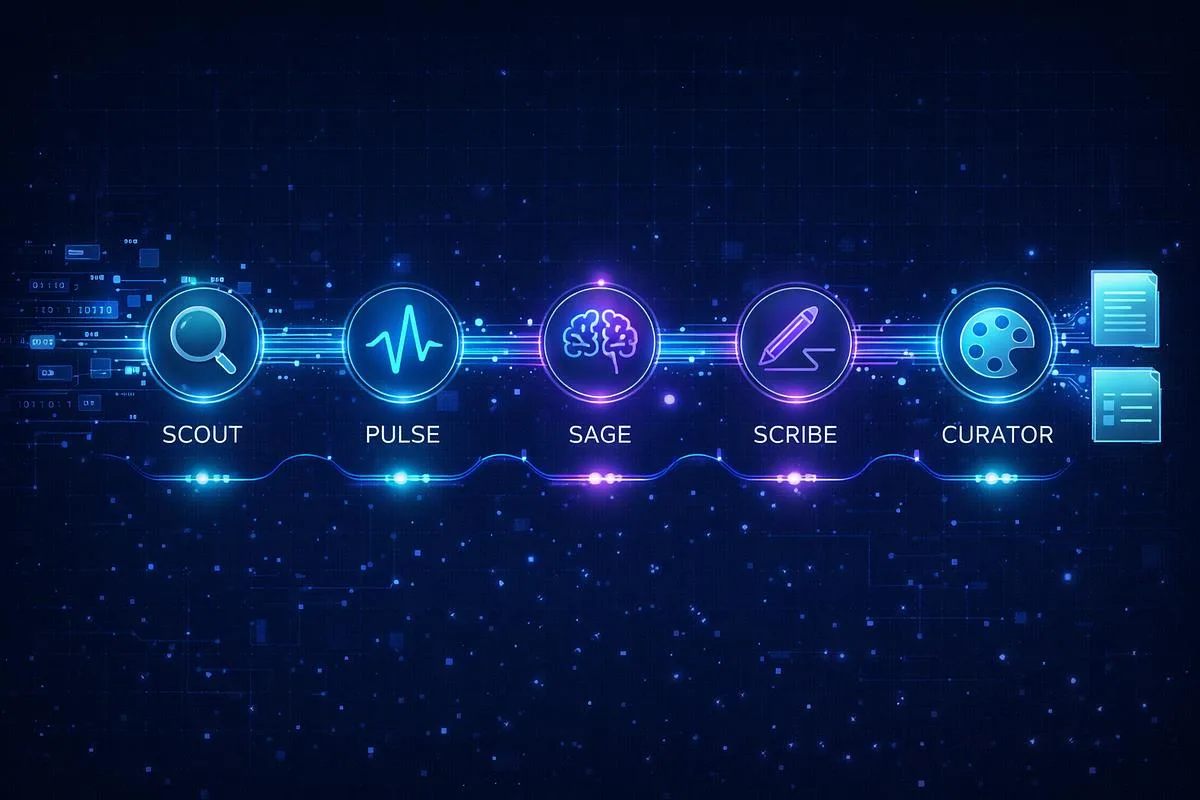
In this approach, agents complete tasks in a defined sequence.
The output from one agent becomes the input for the next.
For example:
Agent 1 extracts invoice details.
Agent 2 validates the information.
Agent 3 compares it with purchase records.
Agent 4 prepares an exception report.
Best suited for: Document processing, structured reviews, and workflows with clear dependencies.
3. Parallel Agent Pattern
Sequential vs. Parallel Agents Architecting for Efficiency in MultiAgent AI Systems
blogs.optimumdataanalytics.com
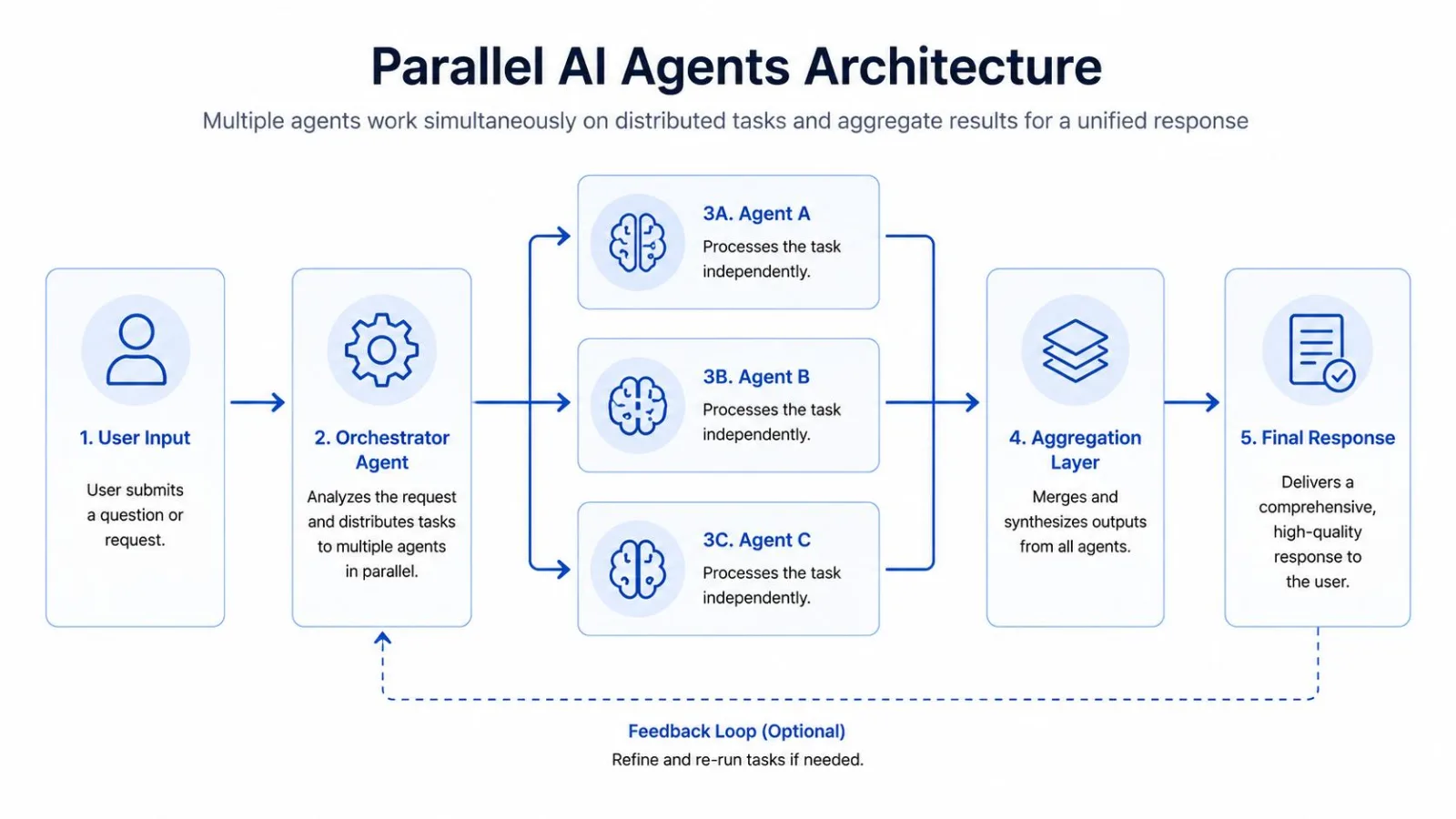
Independent agents perform separate tasks simultaneously. Their results are collected and combined when the required work is complete.
For example, when preparing a business research report, different agents could investigate market conditions, competitor information, customer trends, and technology requirements.
Best suited for: Research, comparison, analysis, and tasks that can be divided into independent workstreams.
4. Collaborative Agent Pattern
In a collaborative arrangement, agents communicate and exchange information to solve a problem.
For example, a planning agent may suggest an inventory adjustment, while a demand analysis agent evaluates the supporting information. A review component checks whether the recommendation follows company rules.
Collaboration requires defined communication protocols and conflict-resolution rules.
Best suited for: Complex analysis and tasks where multiple specialist perspectives are useful.
5. Hybrid Orchestration Pattern
A hybrid architecture combines different coordination approaches.
A business may use a supervisor to manage the overall process, parallel agents to research information, and sequential agents to complete validation and reporting.
Best suited for: Large workflows involving several departments, software platforms, and approval stages.
No pattern is universally best. The architecture should reflect the actual workflow, performance requirements, risk level, and available infrastructure.
Technologies Used to Build Multi-Agent AI Systems in 2026
Building a multi-agent application requires technologies for AI reasoning, orchestration, data retrieval, application development, integrations, and deployment.
The appropriate technology stack depends on the system's complexity and business requirements.
AI Models and Agent Frameworks
AI models provide the reasoning and language capabilities used by agents.
Development teams may select different models for different responsibilities. A lightweight model may handle simple classification, while a more capable model may be used for complex analysis.
Frameworks and orchestration platforms help developers define agents, tools, communication, and workflow execution.
Examples include:
LangGraph.
CrewAI.
These tools have different capabilities and operating requirements. A development team should evaluate model compatibility, workflow control, observability, deployment options, and cost before choosing a platform.
Programming Languages
Common programming choices include:
Technology | Possible role |
|---|---|
Python | AI workflows, data processing, backend services |
JavaScript / TypeScript | Web applications, APIs, and agent integrations |
Java | Enterprise backend applications |
C# / .NET | Business systems and enterprise integrations |
The programming language should match the existing technology environment, development team's expertise, and integration requirements.
Databases and Knowledge Systems
Multi-agent applications may need structured business records as well as unstructured documents.
Examples include:
PostgreSQL for relational business data.
MySQL for application records.
MongoDB for document-oriented data.
Vector databases for semantic retrieval.
Object storage for files and documents.
Search systems for indexed organizational knowledge.
A retrieval-augmented generation approach can help agents retrieve relevant information from approved company documents instead of relying only on general model knowledge.
APIs and Integration Technologies
APIs allow agents to interact with external applications and internal business services.
For example, an agent may retrieve a customer record from a CRM platform or request inventory information from an ERP system.
Common integration methods include:
REST APIs.
Webhooks.
Event-driven messaging.
Secure service-to-service communication.
Database access through controlled backend services.
For businesses that need connected digital infrastructure, cloud and DevOps solutions can support deployment, monitoring, scaling, and maintenance.
Key Benefits of Multi-Agent AI for Businesses
Multi-agent AI systems can offer meaningful operational advantages when they are designed around real business requirements.
1. Better Task Specialization
Each agent can focus on a specific responsibility rather than managing every part of a workflow.
This can make instructions more focused and allow teams to evaluate each agent according to its assigned task.
2. Parallel Processing
Independent activities can run at the same time.
For example, a research workflow may use separate agents to review different documents or data sources before combining their findings.
Parallel execution can reduce total processing time, although the actual improvement depends on task dependencies, model response times, and system infrastructure.
3. More Flexible Business Workflows
A traditional automated workflow often follows a fixed sequence.
Multi-agent orchestration can support conditional routing. If an agent identifies an exception, the system can send the task to a specialist agent or request human review.
This is useful when business processes involve changing inputs and multiple possible outcomes.
4. Improved Integration Between Business Applications
Specialized agents can interact with different systems through controlled APIs.
For example, a sales workflow may involve CRM records, email services, customer databases, and reporting software.
A coordinated system can help move relevant information between these applications without requiring employees to manually repeat every step.
5. Easier Modular Maintenance
When responsibilities are clearly separated, developers can update one agent without necessarily changing every other component.
For example, a company could improve its document extraction agent while keeping the existing approval workflow intact.
However, changes to shared data structures or communication protocols may still require broader testing.
6. More Consistent Operational Visibility
A properly designed system can record which agent received a task, which tools it used, what information it returned, and whether a human approved the final action.
This can help managers understand how automated workflows operate and where errors occur.
Challenges and Limitations of Multi-Agent AI Systems
Multi-agent systems are not automatically more accurate, faster, or cheaper than simpler AI applications.
Adding more agents introduces additional communication, testing, and infrastructure requirements.
Businesses should understand these limitations before investing in development.
1. Coordination Complexity
Every additional agent creates another component that must communicate correctly with the rest of the system.
Poorly defined responsibilities can cause agents to repeat tasks, disagree about results, or pass incomplete information.
How to address it: Define agent responsibilities, input and output formats, task ownership, and escalation rules before development.
2. Higher Operating Costs
Each agent may require model calls, API requests, memory retrieval, and computing resources.
A multi-agent workflow may therefore cost more than a single-agent solution.
How to address it:
Use smaller models for straightforward tasks.
Limit unnecessary agent communication.
Cache reusable information where appropriate.
Set maximum execution and iteration limits.
Monitor token and API consumption.
Avoid creating agents for tasks that can be handled through ordinary software logic.
3. Latency and Processing Delays
A workflow that requires several agents to complete tasks sequentially may take longer than a simple AI request.
Parallel execution can help when tasks are independent, but it does not remove the time required for coordination and final validation.
How to address it: Identify which tasks can run in parallel and which genuinely depend on earlier results.
4. Inconsistent or Incorrect Outputs
AI models can produce inaccurate information, misunderstand instructions, or return inconsistent results.
When one agent passes incorrect information to another, the error may affect the entire workflow.
How to address it: Use structured outputs, validation rules, confidence thresholds where meaningful, and independent checks for important results.
5. Security and Data Privacy Risks
Agents may interact with sensitive business information, external applications, and operational systems.
If permissions are too broad, an agent could access information or perform actions beyond its intended responsibility.
How to address it: Apply least-privilege access, secure authentication, encrypted communication, controlled API access, and comprehensive activity logging.
6. Difficult Testing and Debugging
A workflow involving multiple agents can fail at several points.
The problem may originate in an individual agent, the orchestrator, an API integration, a database, or the information passed between components.
How to address it: Maintain execution traces, test agents independently, simulate failure scenarios, and evaluate complete workflows before production deployment.
Security and Governance in Multi-Agent AI Development
Security should be built into the architecture before agents are connected to business applications.
An AI agent that only summarizes public information has a different risk profile from one that can modify customer records, approve invoices, or operate production infrastructure.
A business should define what each agent can access and what actions it is allowed to perform.
Role-Based Access Control
Each agent should have a defined identity and permission scope.
For example:
A reporting agent may have read-only access to approved sales information.
An inventory agent may retrieve stock levels but not modify financial records.
A procurement agent may prepare purchase requests without independently approving payments.
This reduces the risk of unnecessary access.
Human Approval for Sensitive Actions
Not every AI-generated recommendation should become an automatic business action.
Human approval may be appropriate for:
Financial transactions.
Supplier payments.
Employment decisions.
Customer account restrictions.
Sensitive data changes.
Production infrastructure modifications.
Legal or regulatory communications.
Approval requirements should be based on the business risk and reversibility of each action.
Data Protection and Encryption
Businesses should protect information throughout its lifecycle.
Security measures may include:
Encryption in transit and at rest.
Secure credential management.
Data minimization.
Restricted document retrieval.
Retention and deletion policies.
Secure API authentication.
Protection against prompt injection and malicious inputs.
Monitoring and Audit Trails
Organizations should be able to investigate what happened during an automated workflow.
Useful records include:
Agent identity and task assignment.
Tools and APIs accessed.
Relevant input and output metadata.
Permission checks.
Approval events.
Errors and retry attempts.
Final workflow status.
The World Economic Forum's 2026 guidance on trusted AI agent adoption highlights the importance of authorization, oversight, and accountability as organizations scale agent-based systems.
AWS also provides an Agentic AI Lens within its Well-Architected Framework, covering architecture, reliability, security, cost management, and operational oversight.
World Economic Forum+1
How Businesses Can Implement Multi-Agent AI Systems
Successful implementation begins with a business problem, not a decision to use a particular AI framework.
Organizations should identify a workflow where coordination between specialized tasks can produce a measurable improvement.
Step 1: Identify a Suitable Business Process
Start by reviewing existing operations.
Look for processes that involve:
Repeated information gathering.
Multiple software applications.
Several departments.
Repetitive document handling.
Frequent exceptions.
Delays caused by manual handoffs.
For example, invoice processing may be a suitable starting point if employees spend considerable time retrieving documents, checking purchase orders, and identifying discrepancies.
Step 2: Map the Existing Workflow
Document how the process currently works.
Identify:
Who initiates the task.
Which systems are involved.
What information is required.
Which decisions must be made.
Where human approval is necessary.
What happens when something goes wrong.
This prevents developers from automating an unclear or inefficient process.
Step 3: Define Agent Responsibilities
Create a clear responsibility for each proposed agent.
Avoid assigning several agents the same vague objective.
For an invoice workflow, responsibilities might include document extraction, record retrieval, data matching, exception identification, and report preparation.
Step 4: Select the Orchestration Architecture
Choose an approach that reflects the workflow.
A simple sequential architecture may be sufficient for document processing. A supervisor architecture may be more suitable for a process that routes different requests to different specialist agents.
For larger systems, a hybrid approach may be appropriate.
Step 5: Connect Business Systems
Identify the applications and data sources the agents need.
These may include CRM, ERP, inventory, accounting, document storage, and internal databases.
Use secure APIs and controlled integration services. Avoid giving agents direct unrestricted access to production databases.
Step 6: Establish Security and Approval Rules
Before deployment, define:
Agent identities.
Access permissions.
Allowed tools.
Data retention requirements.
Human approval points.
Execution limits.
Error and escalation procedures.
Step 7: Test Individual Agents and Complete Workflows
Testing should cover more than successful scenarios.
Consider:
Missing information.
Incorrect documents.
Conflicting agent outputs.
API downtime.
Duplicate requests.
Expired credentials.
Unauthorized actions.
Unexpected model responses.
Workflow timeouts.
The objective is to understand how the complete system behaves when something goes wrong.
Step 8: Deploy Gradually and Monitor Performance
Begin with a limited pilot.
Measure whether the system improves the selected process before expanding it to additional departments.
Track useful indicators such as:
KPI | What it measures |
|---|---|
Task completion rate | Percentage of workflows completed successfully |
Exception rate | Frequency of tasks requiring intervention |
Average processing time | Time needed to complete a workflow |
Human intervention rate | How often employees need to step in |
Cost per completed task | AI, infrastructure, and integration costs |
Output accuracy | Quality of agent results against reviewed outcomes |
System availability | Reliability of the supporting application |
These measurements help organizations decide whether multi-agent automation is producing practical value.
Multi-Agent AI Development Cost in 2026
The cost of building a multi-agent AI system depends on the number of agents, workflow complexity, integrations, model selection, infrastructure, security requirements, and testing effort.
There is no universal price for multi-agent AI development.
A small internal workflow may require a relatively limited implementation, while an enterprise platform connecting several departments and production systems can require a much larger engineering investment.
The following figures are illustrative planning estimates in USD, not verified market averages or Galaxium Coding quotations.
Project type | Illustrative development budget | Indicative timeline |
|---|---|---|
Basic two-agent workflow | $8,000–$20,000 | 4–8 weeks |
Department-level automation | $20,000–$50,000 | 2–4 months |
Multi-agent business application | $50,000–$120,000 | 3–6 months |
Enterprise multi-agent platform | $120,000–$300,000+ | 6–12+ months |
Actual requirements may place a project outside these ranges.
Factors That Influence Development Costs
Number and complexity of agents: More agents may require additional design, testing, model calls, and communication logic.
Orchestration requirements: Dynamic routing, parallel execution, workflow recovery, and complex dependencies increase engineering effort.
Business integrations: Connecting to existing CRM, ERP, accounting, and other enterprise systems may require custom API development.
Data infrastructure: Knowledge retrieval, document processing, databases, and data preparation can affect both development and operating costs.
Security requirements: Identity management, permission boundaries, audit trails, testing, and approval workflows require additional engineering.
User interfaces: A web dashboard, mobile application, or employee portal may increase the scope.
Ongoing operations: Model usage, cloud infrastructure, API subscriptions, monitoring, and maintenance contribute to recurring expenses.
How to Control Multi-Agent AI Development Costs
Businesses can manage project budgets by:
Starting with one high-value workflow.
Using a small number of clearly defined agents.
Reusing existing software and APIs.
Selecting models according to task complexity.
Avoiding unnecessary parallel processing.
Testing integrations before expanding the system.
Monitoring operating costs from the pilot stage.
A phased implementation can help businesses validate the benefits before committing to a larger platform.
Multi-Agent AI Trends Businesses Should Watch in 2026
Multi-agent AI development is evolving as organizations explore more advanced ways to coordinate software, data, and automated processes.
Several developments are particularly relevant to businesses planning AI investments.
1. More Specialized AI Agents
Instead of using one general-purpose agent for every task, organizations can create agents focused on specific departments, knowledge areas, or responsibilities.
This can support clearer permissions and more manageable workflows.
2. Greater Use of Parallel Agent Processing
Agents can increasingly be assigned independent tasks at the same time.
For example, separate agents can review different documents, analyze different datasets, or investigate separate technical issues before a coordinating agent combines their findings.
3. Integration with Enterprise Software
Multi-agent systems are becoming more relevant to applications that connect CRM, ERP, customer support, and other business platforms.
The value comes from coordinating work across systems rather than simply generating text.
4. Stronger Focus on Agent Governance
As agents gain the ability to interact with real business systems, organizations need more control over what they can access and execute.
Permission management, traceability, human approval, and ongoing monitoring are becoming important parts of production architecture.
5. More Flexible Model Selection
Different agents do not necessarily need to use the same AI model.
A business may use a smaller model for classification and a more capable model for complex analysis. This can help balance performance and operating costs.
6. Better Evaluation and Observability
Development teams need to measure more than whether an individual agent produces a plausible answer.
They must also evaluate whether the complete workflow reaches the correct outcome, handles failures, respects permissions, and remains within cost and time limits.
These trends point toward a more modular approach to enterprise AI development. They do not mean every business process should become autonomous. The most useful systems will combine AI capabilities with dependable software engineering and appropriate human supervision.
How to Choose a Multi-Agent AI Development Company
Selecting a development partner is an important decision because multi-agent applications combine AI engineering, backend development, software integrations, security, and ongoing maintenance.
Businesses should evaluate potential providers against several practical criteria.
1. Experience with AI Application Architecture
Ask how the development team plans to divide responsibilities between agents and how the orchestrator will manage their communication.
A suitable provider should be able to explain the architecture rather than simply recommend adding more AI models.
2. API and Enterprise Integration Capabilities
Check whether the provider can work with your existing business applications.
This may include CRM, ERP, accounting software, internal databases, and cloud infrastructure.
3. Security and Permission Management
Ask how the system will protect business information and restrict agent actions.
The provider should explain authentication, access control, audit logging, data protection, and human approval requirements.
4. Testing and Monitoring Strategy
Find out how the team will test individual agents and complete workflows.
Ask how errors, failed integrations, conflicting outputs, and unexpected model responses will be detected and handled.
5. Scalability and Ongoing Support
A pilot system may have relatively modest requirements. A production platform supporting several departments may need stronger infrastructure, monitoring, and operational support.
The development partner should explain how the architecture can evolve as business requirements grow.
6. Transparent Project Scope and Ownership
Before development begins, confirm:
What the first release will include.
Which integrations are covered.
Which AI services require separate subscriptions.
Who owns the source code.
How data and credentials will be managed.
What maintenance and support are included.
Businesses can also review Galaxium Coding's projects and portfolio to understand its software development work and solution areas.
How Galaxium Coding Can Support Business AI and Automation Projects
Implementing multi-agent AI requires more than configuring an AI model. It involves designing a complete software environment in which intelligent components can communicate with business applications and operate within defined rules.
Galaxium Coding is a Qatar-based technology and software development company. Its relevant service areas include custom software, web applications, mobile applications, cloud infrastructure, and business-oriented digital solutions.
Depending on project requirements, a business may need:
Custom software to coordinate AI-powered workflows.
Web dashboards for monitoring agent activity.
Backend APIs to connect enterprise applications.
Database systems for business records and workflow state.
Cloud infrastructure for application deployment.
Administrative controls and approval interfaces.
Integration with existing business platforms.
Companies planning a tailored automation platform can explore Galaxium Coding's software development services and cloud and DevOps capabilities.
The right implementation should begin with a clearly defined business challenge, followed by technical planning, a limited pilot, and measurable performance evaluation.
To discuss a potential project, businesses can contact Galaxium Coding.
Final Thoughts
Multi-agent AI systems are creating new opportunities for businesses to automate workflows that involve multiple tasks, applications, and decision points.
By assigning specialized responsibilities to different agents, organizations can coordinate research, customer support, document processing, inventory management, reporting, and other business activities.
However, successful implementation depends on more than the number of agents involved. Clear orchestration, reliable integrations, controlled permissions, accurate outputs, and human oversight are essential.
In 2026, businesses should focus on identifying workflows where collaboration between specialized agents can solve a genuine operational problem. Starting with a small, measurable use case is often more practical than attempting to automate an entire organization at once.
With the right architecture and development strategy, multi-agent AI can become a valuable part of a company's long-term digital transformation.
Frequently Asked Questions (FAQs)
1. What are multi-agent AI systems?
Multi-agent AI systems are software architectures in which multiple specialized AI agents collaborate to complete tasks. Each agent has a defined responsibility, and an orchestrator coordinates their activities and combines their results.
2. How do multi-agent AI systems work?
They work by receiving a request, dividing it into smaller tasks, assigning those tasks to specialized agents, collecting their outputs, and coordinating the final result. Depending on the workflow, agents may operate sequentially or in parallel.
3. What is the difference between single-agent and multi-agent AI?
A single-agent system relies on one primary agent to handle a task or a group of related tasks. A multi-agent system distributes responsibilities among several specialized agents. Multi-agent systems can support more complex workflows but introduce additional coordination and operating costs.
4. What is an AI agent orchestrator?
An AI agent orchestrator is the component responsible for coordinating agents. It assigns tasks, manages communication, tracks workflow progress, handles errors, and determines when a process should continue or be escalated.
5. Which industries can benefit from multi-agent AI?
Retail, healthcare administration, education, logistics, manufacturing, real estate, finance, and professional services can explore multi-agent AI for suitable workflows. The best applications depend on each industry's processes, data, and security requirements.
6. Can multi-agent AI integrate with CRM and ERP systems?
Yes. Multi-agent applications can connect with CRM and ERP platforms through APIs and controlled integration services. This allows agents to retrieve approved information, prepare updates, and coordinate business processes.
7. Is multi-agent AI more expensive than single-agent AI?
It can be. Multiple agents may require additional model calls, API requests, computing resources, testing, and orchestration. However, the overall business value depends on the complexity of the workflow and the manual work it can reasonably reduce.
8. Is multi-agent AI secure for enterprise applications?
It can be designed for enterprise use, but security depends on implementation. Important controls include role-based access, least-privilege permissions, encryption, secure API integrations, audit logs, and human approval for sensitive actions.
9. How long does it take to develop a multi-agent AI system?
A limited two-agent workflow may take several weeks, while a larger enterprise platform can require several months or longer. Timelines depend on agent complexity, integration requirements, data readiness, testing, and deployment scope.
10. Does every business need multi-agent AI automation?
No. Many businesses can achieve their objectives with traditional software automation or a single AI agent. Multi-agent architecture is most useful when tasks require distinct specializations, cross-system coordination, or parallel processing.
11. Can multi-agent AI work without human supervision?
Some low-risk tasks can operate with limited supervision after appropriate testing. However, financial transactions, employment decisions, sensitive data changes, and other high-impact actions should have suitable human oversight and authorization.
12. How can a business start implementing multi-agent AI?
A business should first identify a suitable workflow, document its existing process, define agent responsibilities, choose an orchestration approach, and connect the required systems. A limited pilot with measurable KPIs can help validate the solution before wider deployment.