Digital Transformation in Qatar 2026: The Complete Guide to Websites, Software, Mobile Apps, AI & Business Automation
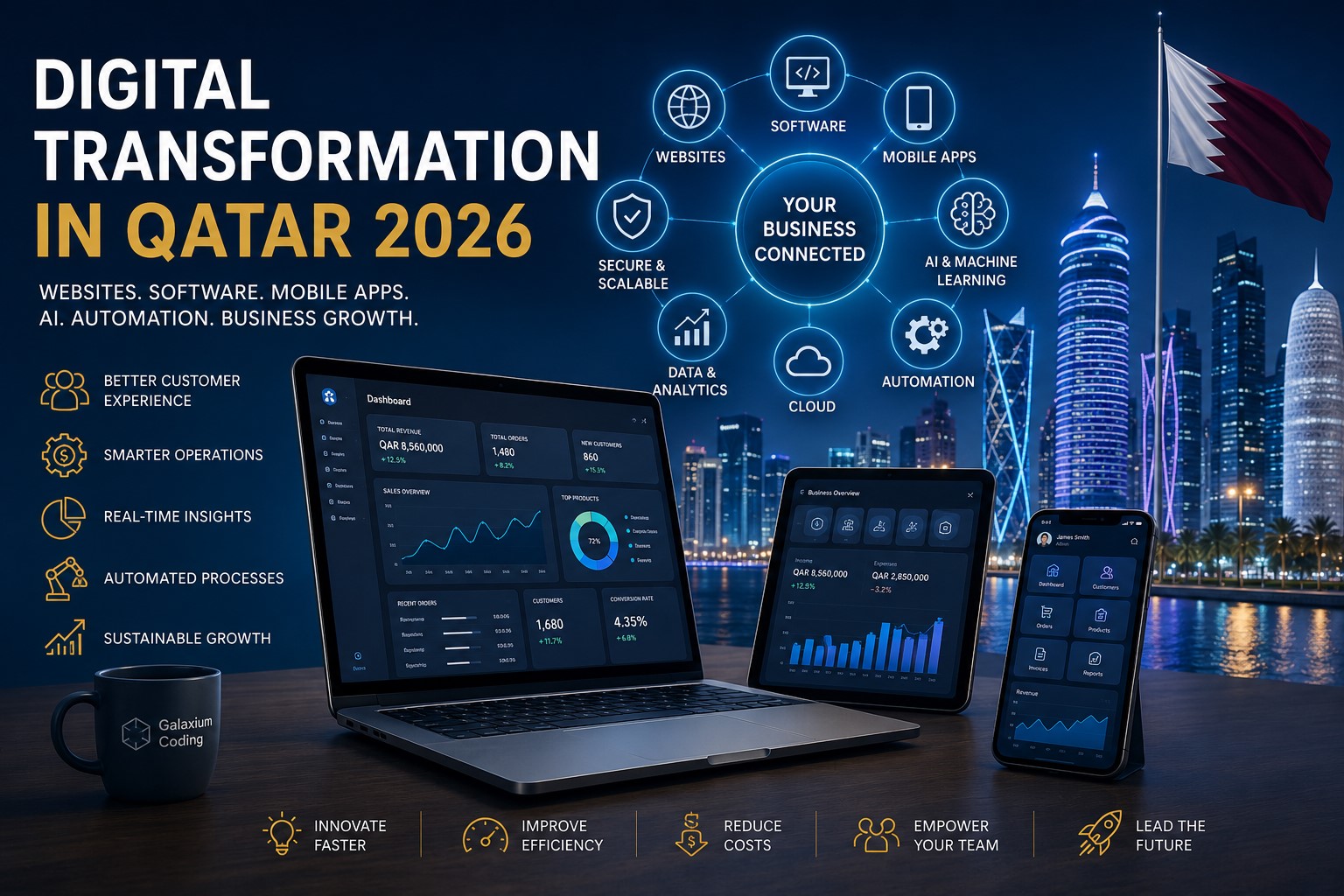
Digital transformation connects websites, software, mobile applications, cloud platforms, AI and business automation to create smarter connected businesses in Qatar.
Digital Transformation in Qatar 2026: The Complete Guide to Websites, Software, Mobile Apps, AI & Business Automation
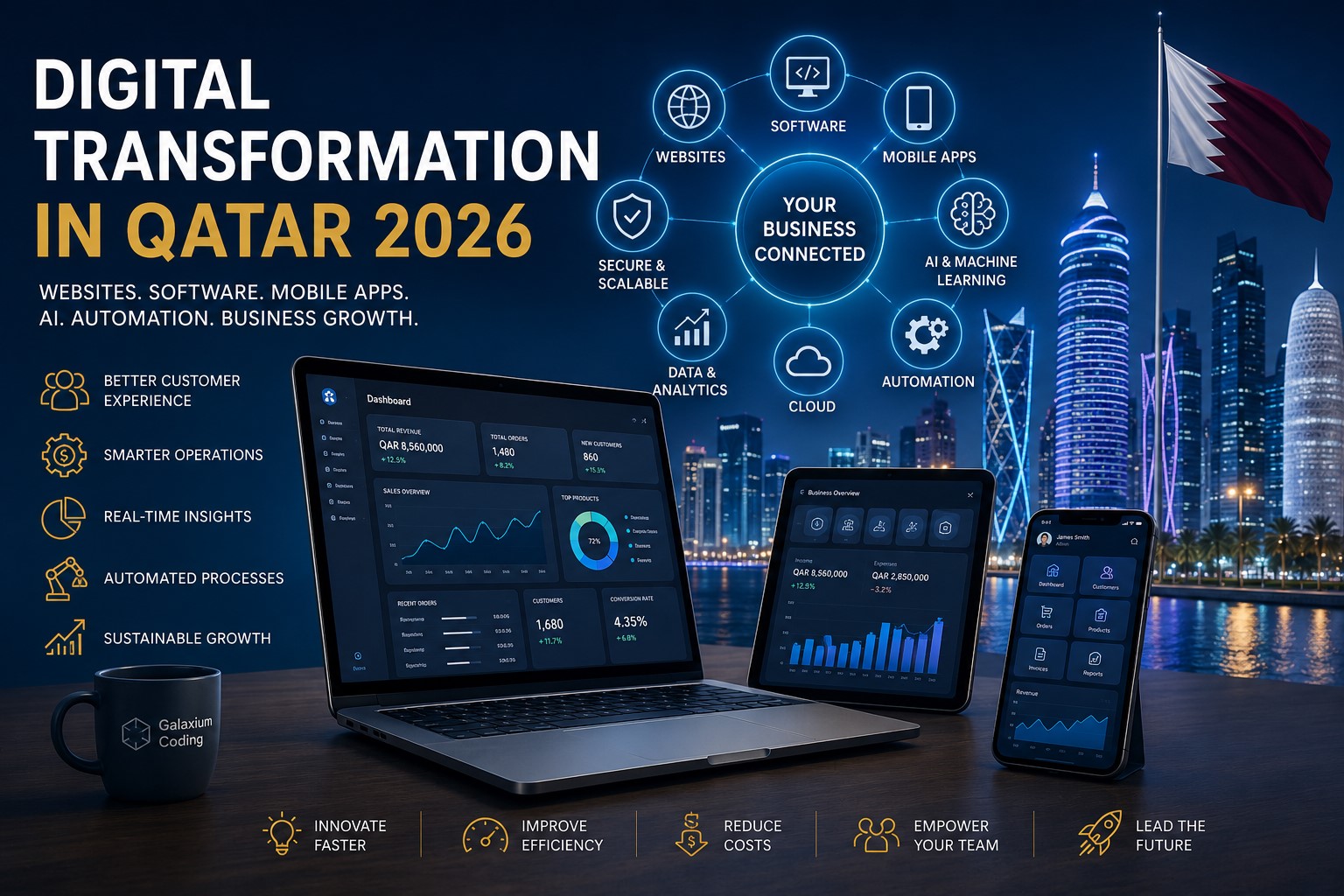
Qatar is rapidly becoming one of the region's most technology-focused business environments. As organizations adopt digital tools, artificial intelligence, cloud platforms, mobile applications and automated business systems, digital transformation is becoming much more than simply creating a website.
For a modern business, digital transformation can mean connecting the entire organization:
Website → Customers → CRM → Sales → Operations → Accounts → Inventory → HR → Mobile App → Cloud → AI → Automation → Management Analytics
The goal is not to use technology simply because it is new.
The goal is to use technology to make a business more efficient, easier to manage, easier to scale and more connected to its customers.
For businesses in Qatar, this creates an important question:
What does digital transformation actually mean, and where should a business start?
This complete guide explains the major technologies involved in digital transformation in Qatar in 2026, how they work together, what businesses can build, what industries can benefit, and how to choose the right technology partner.
What Is Digital Transformation?
Digital transformation is the process of using digital technology to improve how a business operates, communicates with customers, manages information and delivers products or services.
It can involve much more than replacing paper with computers.
A digitally transformed business may use:
Professional websites
E-commerce platforms
Web applications
Custom business software
CRM systems
ERP systems
HR management systems
Accounting systems
Inventory management
Customer portals
Employee portals
Mobile applications
Cloud infrastructure
Artificial intelligence
AI agents
Voice assistants
Business automation
Data analytics
APIs and system integrations
Digital payment systems
Online booking systems
Customer notifications
Dashboards and reporting
The most important part is not any individual technology.
It is the connection between the technologies.
For example:
Customer visits website
↓
Customer submits enquiry
↓
CRM receives lead
↓
Sales representative is notified
↓
Customer receives automated response
↓
Sales activity is recorded
↓
Management sees the result on dashboard
↓
AI analyzes customer activity
This is digital transformation in practice.
Why Digital Transformation Matters for Businesses in Qatar
Businesses operating in Qatar are increasingly competing in an environment where customers expect convenience, speed and digital accessibility.
Customers may expect to:
Find a company through Google
Visit its website
Contact the business through WhatsApp
Request a quotation online
Book an appointment
Purchase products online
Track an order
Receive notifications
Access documents
Make digital payments
Communicate through a mobile application
Receive immediate answers from an AI assistant
At the same time, business owners and managers need better visibility into their operations.
They may want to know:
How many leads arrived today?
Which salesperson converted the most customers?
Which products are selling?
What inventory is available?
Which invoices are overdue?
Which employees are working on which tasks?
How much revenue was generated?
Which customers are returning?
Which marketing channel generates the most enquiries?
Digital systems can bring this information together.
Instead of managing different parts of the business through spreadsheets, disconnected applications, paper documents and manual communication, companies can gradually create a connected digital ecosystem.
Digital Transformation Is Not Only for Large Companies
One common misconception is that digital transformation is only for multinational corporations.
That is no longer the case.
A small business can start with a professional website.
A growing company may add:
Website
↓
Customer Database
↓
CRM
↓
Business Management Software
↓
Mobile Application
↓
AI
↓
Automation
A larger company may require:
Enterprise Software
↓
ERP
↓
CRM
↓
HR
↓
Accounting
↓
Inventory
↓
Cloud Infrastructure
↓
Business Intelligence
↓
AI Automation
The important principle is to build technology according to the company's actual requirements.
A business does not necessarily need every technology on day one.
Step 1: Build a Strong Digital Presence
For many businesses, the first stage of digital transformation is a professional website.
A modern business website can provide:
Company information
Products and services
Contact information
Location
Google Maps
Enquiry forms
Booking systems
Customer communication
Portfolio and case studies
Blog and educational content
Search engine visibility
E-commerce
Payment integration
Customer accounts
Online applications
AI assistants
Your website can become the public entry point into your entire digital ecosystem.
For example:
Google Search
↓
Website
↓
Lead Form
↓
CRM
↓
Sales Team
Instead of being just an online brochure, the website becomes a business tool.
For businesses looking for professional website development, Galaxium Coding provides custom website development and digital solutions designed around business requirements.
Website Development Company in Qatar — Galaxium Coding
Step 2: Move From a Website to a Web Application
A website mainly provides information and customer-facing functionality.
A web application can go much further.
A web application can provide logged-in experiences, dashboards, databases, workflows and business operations.
Examples include:
CRM platforms
HR systems
Real estate management systems
Pharmacy management systems
Customer portals
Employee portals
Booking platforms
E-commerce platforms
Project management systems
Business dashboards
SaaS platforms
Inventory systems
Document management systems
For example, a real estate company could create a web application where:
Admin
→ Adds properties
Agents
→ Manage listings
Customers
→ Search properties
Sales team
→ Manage enquiries
Management
→ Views performance
All of these functions can operate inside one connected platform.
Galaxium Coding's web application services include progressive web applications, e-commerce platforms, SaaS applications and real-time business dashboards.
Web Applications — Galaxium Coding
Step 3: Build Custom Business Software
As a company grows, standard software may no longer fit every workflow.
A business may find itself using:
One system for customers
Another for accounting
Spreadsheets for inventory
WhatsApp for communication
Email for approvals
Separate HR software
Another application for reporting
This can create duplicated information and manual work.
Custom software can bring important processes together.
For example:
Sales
↓
CRM
↓
Accounts
↓
Inventory
↓
HR
↓
Projects
↓
Management Dashboard
A custom system can be designed around the company's actual workflow instead of forcing the company to completely change its operations to match generic software.
Galaxium Coding's software development services include custom software, enterprise systems, ERP and CRM-style platforms, cloud-native applications, databases, integrations, security-focused development and ongoing maintenance.
Custom Software Development — Galaxium Coding
Step 4: Use Mobile Applications to Stay Connected With Customers
Mobile applications have become an important part of digital business.
A mobile app can allow customers to:
Create accounts
Place orders
Make payments
Request services
Book appointments
Track orders
Receive notifications
View documents
Communicate with businesses
Manage subscriptions
Earn loyalty rewards
Mobile applications can also be used internally.
Employees can use mobile apps for:
Attendance
Field services
Job assignments
Customer visits
Delivery management
Sales
Approvals
Reporting
Task management
For example, a cleaning company could allow customers to book cleaning services through an app.
A pharmacy could provide online ordering and delivery.
A real estate company could allow customers to search properties and schedule appointments.
A service company could allow customers to create service requests and track their progress.
The mobile application becomes another connection between the company and its customers.
Mobile Applications — Galaxium Coding
Step 5: Add E-Commerce
For businesses selling products, digital transformation can include building an e-commerce platform.
A modern e-commerce system may include:
Product catalogue
Categories
Product search
Filters
Shopping cart
Customer accounts
Checkout
Payment gateways
Order management
Inventory
Delivery integration
Promotions
Discount codes
Notifications
Customer support
Analytics
But e-commerce should not operate as an isolated website.
A stronger system can connect:
E-Commerce
↓
Payment
↓
Order Management
↓
Inventory
↓
Delivery
↓
Customer Notification
↓
Accounting
This reduces unnecessary manual work and gives management greater visibility.
Step 6: Connect Your Business Systems
One of the most important stages of digital transformation is integration.
Businesses often have multiple systems that need to exchange information.
For example:
Website
↔
CRM
↔
Accounting
↔
Inventory
↔
Mobile App
↔
Payment System
↔
AI
APIs and integrations can allow these systems to communicate.
For example:
A customer submits a website enquiry.
↓
The CRM creates a lead.
↓
The sales representative receives a notification.
↓
The customer receives an automated acknowledgement.
↓
The sales representative updates the lead.
↓
Management sees the conversion data.
Without integration, employees may have to enter the same information several times.
With integration, information can move automatically between systems where appropriate.
Step 7: Introduce Cloud Technology
Cloud technology has become an important part of modern software architecture.
Cloud platforms can support:
Application hosting
Databases
File storage
Backups
APIs
Analytics
Scalable infrastructure
Deployment
Monitoring
Disaster recovery
Business applications
Cloud-native applications can also be designed to scale as the business grows.
A small company may start with a modest infrastructure.
As traffic and usage increase, the architecture can be expanded.
Galaxium Coding provides cloud and DevOps capabilities as part of its technology services.
Cloud & DevOps — Galaxium Coding
Step 8: Use Artificial Intelligence
Artificial intelligence is becoming one of the most important components of digital transformation.
Businesses can use AI for:
Customer support
Lead qualification
Document processing
Data analysis
Voice assistants
AI agents
Appointment scheduling
Internal knowledge search
Report generation
Content assistance
Recommendations
Workflow automation
Customer communication
Consider a traditional customer-service process:
Customer
↓
Employee reads message
↓
Employee searches for information
↓
Employee responds
↓
Employee updates system
With an integrated AI system:
Customer
↓
AI understands request
↓
System retrieves permitted information
↓
AI responds
↓
CRM is updated
↓
Employee is notified when human intervention is required
AI does not necessarily mean replacing employees.
In many cases, the objective is to allow employees to spend more time on complex work while automation handles repetitive tasks.
Step 9: Build AI Agents
AI agents can take digital transformation further.
A conventional chatbot may answer questions.
An AI agent can potentially interact with business systems and perform defined tasks according to its permissions and workflow.
For example:
Customer
"Can I book an appointment tomorrow?"
↓
AI Agent
Checks availability.
↓
System
Returns available times.
↓
AI Agent
Offers options.
↓
Customer
Selects a time.
↓
System
Creates appointment.
↓
Customer
Receives confirmation.
The same concept can be applied to:
Sales
Customer support
Appointment booking
Lead qualification
Internal employee assistance
Document processing
Reporting
Follow-ups
Business workflows
The important part is that AI should be connected to reliable business data and controlled workflows.
Step 10: Automate Repetitive Business Processes
Automation can reduce the amount of repetitive manual work performed by employees.
Examples include:
Lead Automation
Website enquiry
↓
CRM lead
↓
Sales notification
↓
Follow-up reminder
Order Automation
Customer order
↓
Payment verification
↓
Inventory update
↓
Delivery request
↓
Customer notification
HR Automation
Employee request
↓
Manager approval
↓
HR record
↓
Notification
Invoice Automation
Completed service
↓
Invoice generation
↓
Customer notification
↓
Payment tracking
The best automation opportunities are usually repetitive processes where employees perform the same steps again and again.
Step 11: Create Management Dashboards
Digital transformation should not only automate work.
It should help management understand the business.
A management dashboard can display:
Sales
Revenue
Expenses
Leads
Conversion rates
Orders
Inventory
Employee performance
Projects
Customer activity
Outstanding payments
Operational metrics
Instead of waiting for employees to prepare reports manually, management can potentially access information through a centralized dashboard.
This creates a more data-driven approach to decision making.
Step 12: Protect Business Data
Digital transformation also increases the importance of cybersecurity.
Businesses may store:
Customer information
Employee information
Financial records
Contracts
Documents
Payment information
Business data
Login credentials
Security should therefore be considered during system design.
Important areas include:
Authentication
Authorization
Role-based permissions
Encryption
Secure APIs
Database security
Backups
Server security
Monitoring
Access control
Disaster recovery
Data retention
Security should not be treated as something to add after the software has already been built.
It should be considered from the beginning.
Step 13: Make Your Digital Platforms Bilingual
For many businesses in Qatar, Arabic and English support can be an important part of digital transformation.
A professional bilingual platform may require:
English content
Arabic content
RTL layout
LTR layout
Arabic typography
Bilingual navigation
Bilingual forms
Mobile optimization
Arabic SEO metadata
Appropriate URL structure
Simply translating the English website is not always enough.
The user experience should be designed for both languages.
Which Industries Can Benefit From Digital Transformation?
Almost every industry can benefit from better technology.
Healthcare
Possible solutions include:
Patient portals
Appointment systems
Pharmacy platforms
Medical management software
Online consultations
Patient notifications
Digital records
Finance
Possible solutions include:
Customer portals
Financial dashboards
Document management
Workflow automation
Secure applications
Reporting systems
Retail & E-Commerce
Possible solutions include:
E-commerce
Inventory systems
POS integration
Customer loyalty
Mobile applications
Payment integration
Delivery systems
Real Estate
Possible solutions include:
Property portals
Property management
CRM
Customer accounts
Agent dashboards
Property search
Appointment systems
Mobile applications
Education
Education organizations can use:
Learning management systems
Virtual classrooms
Student information systems
Assignment management
Online assessments
Progress tracking
Galaxium Coding provides education technology solutions including LMS platforms, virtual classrooms, student information systems, assignment management and progress tracking.
Education Technology — Galaxium Coding
Construction
Possible solutions include:
Project management
Procurement
Employee management
Inventory
Site reporting
Document management
Customer portals
Professional Services
Law firms, consulting companies, accounting firms and other professional organizations can benefit from:
Customer portals
Document management
Appointment systems
CRM
Workflow automation
Billing
Reporting
What Should a Business Build First?
One of the biggest mistakes businesses can make is trying to build everything at once.
A better approach is to create a technology roadmap.
Stage 1 — Digital Presence
Build:
Professional website
Google visibility
Contact channels
SEO foundation
Stage 2 — Customer Management
Add:
CRM
Customer database
Lead management
Follow-up automation
Stage 3 — Business Operations
Add:
HR
Accounting
Inventory
Projects
Procurement
Business dashboards
Stage 4 — Mobile
Add:
Customer application
Employee application
Service application
Stage 5 — Cloud
Connect:
Hosting
Databases
APIs
Storage
Monitoring
Backups
Stage 6 — AI
Introduce:
AI assistants
AI agents
Voice AI
AI analytics
AI-powered automation
Stage 7 — Advanced Automation
Connect the entire ecosystem.
Website
↓
CRM
↓
ERP / Business Software
↓
Mobile
↓
Cloud
↓
AI
↓
Automation
This approach allows technology to grow with the company.
How Much Does Digital Transformation Cost in Qatar?
There is no universal digital transformation price.
The cost depends on the business and the technology required.
Factors can include:
Number of users
Number of modules
Website requirements
Mobile applications
Software complexity
Database requirements
Integrations
Payment systems
Cloud infrastructure
AI functionality
Security requirements
Automation requirements
Reporting
Maintenance
Support
A simple business website is very different from an enterprise platform connecting CRM, HR, accounting, inventory, mobile applications and AI.
The best way to determine the cost is therefore to begin with the business requirements.
Before requesting a quotation, define:
What problem are you trying to solve?
Who will use the system?
What processes should be automated?
What information needs to be stored?
What systems need to be connected?
Do customers need a mobile application?
Does the business need AI?
Does the system require Arabic and English?
What level of security is required?
What should the system eventually become?
How to Choose a Digital Transformation Company in Qatar
Choosing the right technology partner is one of the most important decisions.
Do not choose a company only because it offers the lowest price.
Look at:
Experience
Review previous projects and relevant industries.
Technology
Understand which technologies will be used and why.
Scalability
Ask whether the platform can grow as your business grows.
Security
Understand how data, accounts, APIs and infrastructure will be protected.
Integrations
Make sure the development company understands how your existing systems will connect.
Support
Ask what happens after launch.
Documentation
Make sure the system is properly documented.
Ownership
Clarify ownership of software, source code, databases and intellectual property.
Communication
A technology project requires continuous communication between the business and development team.
Long-Term Partnership
Digital transformation is not always a one-time project.
Businesses often require:
Updates
Improvements
Security patches
New features
Infrastructure changes
AI upgrades
Integrations
Monitoring
Technical support
Choose a partner that can support the business beyond the initial launch.
Why Galaxium Coding?
Galaxium Coding is a Qatar-based technology company focused on helping businesses build modern digital solutions.
The company's services include:
Custom software development
Enterprise systems
Web applications
Mobile applications
E-commerce
Cloud and DevOps
AI integration
Business automation
CRM solutions
ERP-style business platforms
Customer portals
Employee systems
Dashboards
API integrations
Galaxium Coding's approach is centered around understanding the business requirement first and then selecting the technology that makes sense for the project.
The company's software development capabilities include requirement analysis, Agile development, quality assurance, deployment, maintenance, scalable architecture, documentation and support.
Software Development — Galaxium Coding
The company also provides web application development using modern technologies and architectures.
Web Applications — Galaxium Coding
For businesses that need mobile technology, Galaxium Coding develops mobile applications that can connect customers, employees and business systems.
Mobile Applications — Galaxium Coding
Cloud infrastructure and DevOps can provide the foundation for scalable digital platforms.
Cloud & DevOps — Galaxium Coding
Businesses can also review Galaxium Coding's completed work and technology projects through its portfolio.
Galaxium Coding Projects & Portfolio
To learn more about the company, its mission, capabilities and industries served:
Digital Transformation and Qatar's Future
Qatar's long-term development is closely connected with technology, innovation, economic diversification and the development of a knowledge-based economy.
For businesses, this creates an opportunity.
Companies that invest in digital infrastructure can potentially improve:
Customer experience
Operational efficiency
Business visibility
Employee productivity
Decision making
Scalability
Communication
Automation
Innovation
The future of business technology is unlikely to be one individual application.
It is increasingly becoming a connected ecosystem.
Software + Mobile + Cloud + AI + Data + Automation
These technologies can work together to create businesses that are more connected, measurable and responsive.
The Future Business Model
Imagine a business where:
A customer discovers the company through Google.
↓
The customer visits the website.
↓
An AI assistant answers questions.
↓
The customer submits an enquiry.
↓
The CRM automatically creates a lead.
↓
The sales team receives a notification.
↓
The customer receives a quotation.
↓
The customer pays online.
↓
The order enters the business system.
↓
Inventory is updated.
↓
The customer receives a mobile notification.
↓
Management sees the transaction on a dashboard.
↓
AI analyzes the business data.
↓
Automation identifies the next action.
This is the direction in which modern business technology is moving.
The objective is not to automate everything simply because automation is possible.
The objective is to remove unnecessary manual work while giving people better information and better tools.
Final Thoughts
Digital transformation in Qatar is no longer simply about having a modern website.
It can involve transforming the way an entire business operates.
A company may begin with a website.
Then add e-commerce.
Then CRM.
Then custom business software.
Then a mobile application.
Then cloud infrastructure.
Then AI.
Then advanced automation.
Each stage can build on the previous one.
The most successful digital transformation strategy is therefore not necessarily the one that uses the most technology.
It is the one that solves the right business problems.
If your company is planning a website, web application, mobile application, custom software system, cloud platform, AI solution or business automation project in Qatar, start by identifying the processes that need to improve.
Then build the technology around the business.
Your digital transformation journey can start with one idea, one problem and one well-designed solution.
Galaxium Coding helps businesses turn technology ideas into practical digital solutions — from websites and mobile applications to custom software, cloud platforms, AI integration and business automation.
Useful Galaxium Coding Resources
For additional information, visitors can explore: