AI Chatbot Development Cost in Qatar: Complete Guide
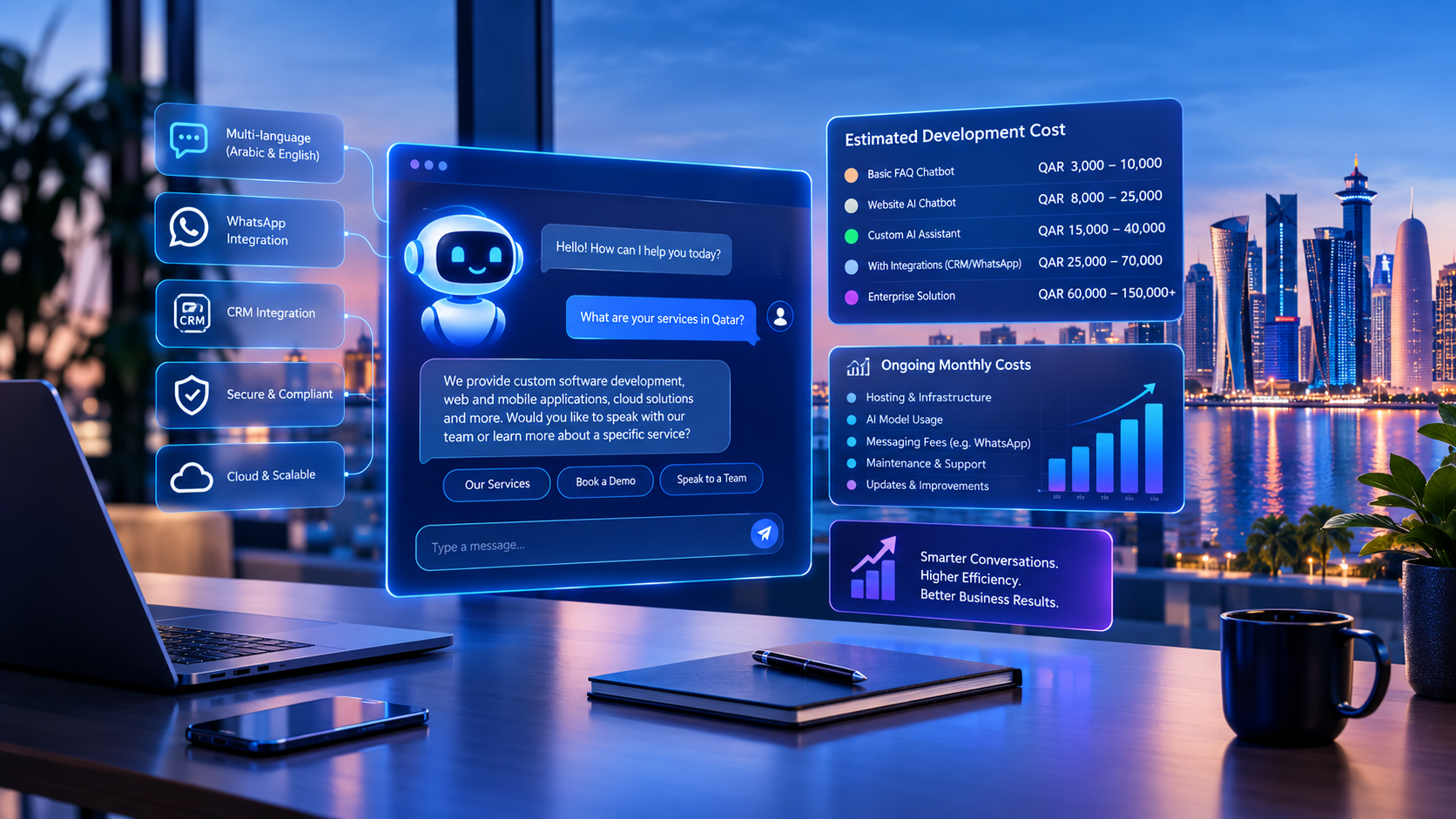
Understanding AI chatbot development costs, integrations, and operating expenses for businesses in Qatar.
AI Chatbot Development Cost in Qatar: Complete Guide (2026)
Businesses in Qatar are increasingly exploring artificial intelligence to improve customer service, automate repetitive tasks, and respond to customer enquiries more efficiently. One practical starting point is an AI chatbot that can answer questions, qualify leads, recommend services, or connect customers with the right department.
However, how much does AI chatbot development cost in Qatar?
The answer depends on the chatbot's capabilities, the information it needs to access, the communication channels it supports, and the level of customization required. A basic FAQ chatbot is significantly different from a custom AI assistant connected to a company's CRM, booking platform, inventory, or internal business software.
This guide explains the main cost factors, common chatbot types, estimated budgets, recurring expenses, implementation process, and important considerations for businesses planning an AI chatbot project in Qatar.
Whether you operate a retail business, real estate company, healthcare organization, educational institution, or professional services firm, understanding these factors can help you plan your investment more effectively.
How Much Does AI Chatbot Development Cost in Qatar?
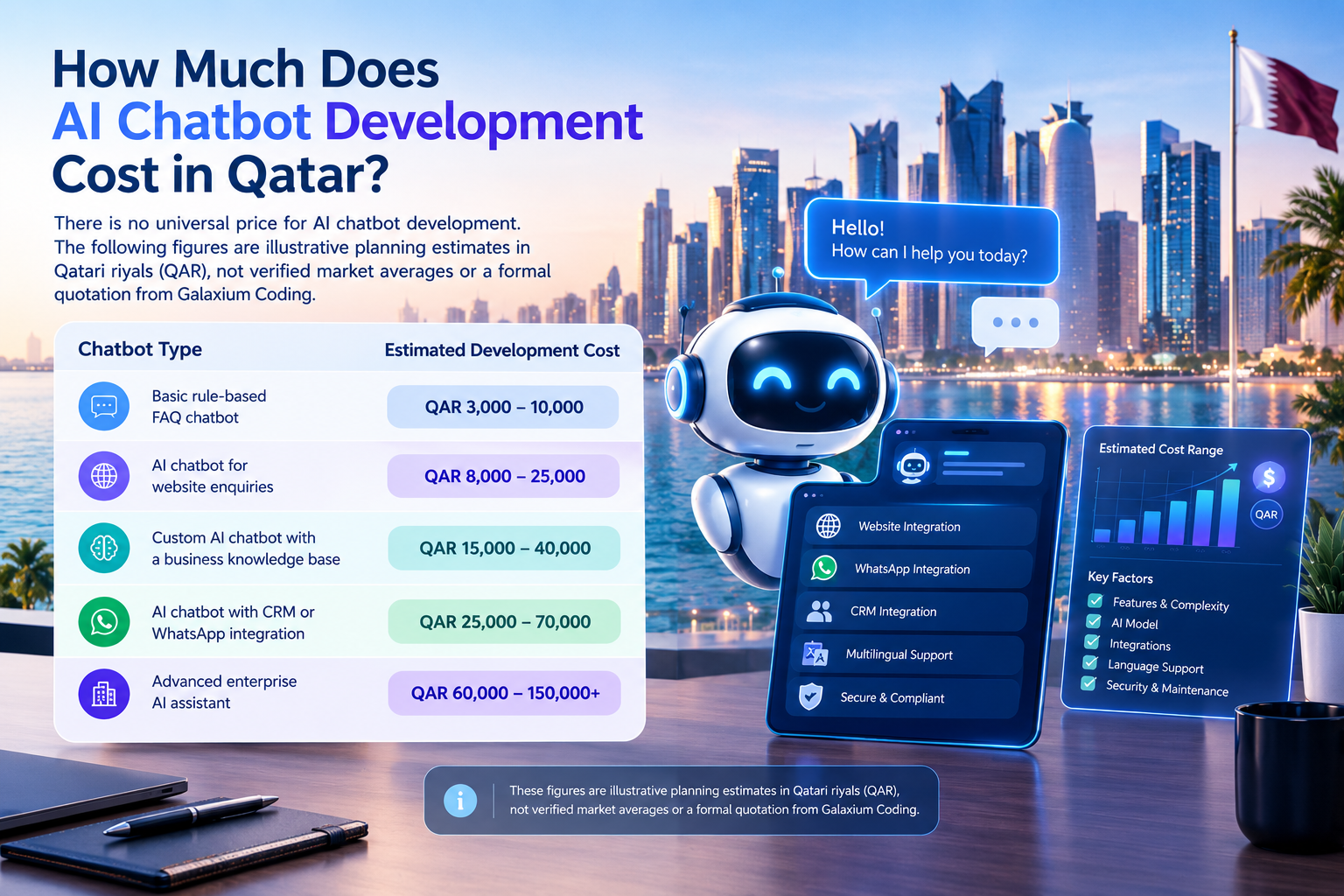
There is no universal price for AI chatbot development. The following figures are illustrative planning estimates in Qatari riyals (QAR), not verified market averages or a formal quotation from Galaxium Coding.
Chatbot type | Estimated development cost |
|---|---|
Basic rule-based FAQ chatbot | QAR 3,000–10,000 |
AI chatbot for website enquiries | QAR 8,000–25,000 |
Custom AI chatbot with a business knowledge base | QAR 15,000–40,000 |
AI chatbot with CRM or WhatsApp integration | QAR 25,000–70,000 |
Advanced enterprise AI assistant | QAR 60,000–150,000+ |
These ranges are intended to help businesses understand potential project sizes. Actual quotations may fall outside them depending on the developer, project scope, technical requirements, and ongoing service commitments.
A project may cost less when it uses an existing chatbot platform and standard integrations. A custom-built solution can require a larger initial investment when it needs specialized workflows, advanced access controls, multiple systems, or complex data processing.
It is also important to distinguish development costs from recurring expenses. AI model usage, hosting, messaging fees, monitoring, and ongoing maintenance may be billed separately.
What Is AI Chatbot Development?
AI chatbot development is the process of designing and building software that communicates with users through text or, in some cases, voice. Depending on its design, a chatbot may follow predefined rules, use artificial intelligence to interpret questions, or combine AI with business automation.
Traditional chatbots generally follow scripted conversations. AI-powered chatbots can interpret different ways of asking a question and generate responses using a language model, a controlled knowledge base, or connected business information.
For example, a property company in Qatar could use a chatbot to:
Answer questions about available properties.
Collect a prospective buyer's preferred location and budget.
Explain the next steps for arranging a viewing.
Capture contact details with appropriate consent.
Forward qualified leads to a sales representative.
Connect enquiries to a CRM for follow-up.
The complexity increases if the chatbot must retrieve live property availability, schedule appointments, update customer records, or interact with several external systems.
Businesses planning a broader digital solution can explore custom software development services to understand how tailored applications and business workflows can be built around specific operational requirements.
What Factors Affect AI Chatbot Development Cost in Qatar?
1. Chatbot Complexity and Features
The most important cost factor is what the chatbot must actually do.
A simple chatbot might display answers to frequently asked questions, collect a name and email address, and direct visitors to a contact form.
An advanced chatbot might need to understand complex requests, retrieve information from company documents, recognize returning customers, perform authorized actions, and transfer conversations to human agents.
Features that may increase development effort include:
Natural language understanding.
AI-generated responses.
Knowledge-base search.
Customer authentication.
Appointment scheduling.
Lead qualification.
Personalized recommendations.
CRM and ERP integration.
Human-agent handover.
Analytics and conversation reporting.
Multilingual conversations.
Voice interaction.
The most cost-effective approach is to begin with the essential features and introduce advanced capabilities when there is a clear business need.
2. AI Model Selection
The AI model influences response quality, latency, capabilities, and operating expenses.
A chatbot built around a language model may need to interpret questions, summarize information, classify customer intent, or generate conversational answers. More capable models can be useful for complex tasks, but they may also cost more to operate.
Model selection should consider:
The complexity of customer questions.
The expected number of conversations.
The average length of each conversation.
The accuracy required.
Response speed.
Multilingual performance.
The need for tool calling or structured outputs.
The cost of processing and generating tokens.
For some businesses, a smaller model is sufficient for routine enquiries. Others may need a more capable model for complicated questions or specialized workflows.
Developers can also use different models for different tasks. For example, a lower-cost model could classify incoming enquiries while a more capable model handles complex questions.
For current usage-based pricing, consult the official OpenAI API pricing page. API costs should be evaluated separately from software development fees.
3. Website or Application Integration
A chatbot that operates on a single website may be simpler to implement than one that must work across several digital channels.
Potential integration requirements include:
Corporate websites.
E-commerce stores.
Customer portals.
Android and iOS applications.
Internal employee platforms.
Appointment booking systems.
Customer support software.
If a business needs a custom interface or customer portal alongside the chatbot, web application development may form part of the project.
Integration work can involve API configuration, authentication, error handling, data mapping, testing, and ongoing compatibility checks. The more systems involved, the more time the project may require.
4. WhatsApp Integration
Businesses in Qatar may want to communicate with customers through WhatsApp rather than asking them to visit a website.
Depending on the implementation, a WhatsApp chatbot may support:
Automated responses to incoming messages.
Lead collection.
Product or service enquiries.
Appointment reminders.
Order-status updates.
Customer-service routing.
CRM record creation.
The cost depends on whether the project uses an existing platform, an approved WhatsApp Business Platform integration, or a more customized messaging architecture.
Messaging-provider charges, eligible conversation or template-message fees, platform subscriptions, and AI usage may be separate from the development quotation. Current charges and rules should be checked with the selected provider before budgeting.
5. Arabic and English Language Support
Qatar's business environment makes language an important design consideration for many customer-facing chatbots.
An English-only chatbot may be sufficient for a business with a specific audience. Other organizations may need Arabic and English support, including language selection, translated interface elements, and appropriate handling of Arabic text.
A multilingual chatbot may require additional work for:
Arabic and English knowledge-base preparation.
Language detection.
Right-to-left interface layouts.
Arabic search and text processing.
Translation quality assurance.
Testing different writing styles and dialects.
Maintaining consistent answers across both languages.
Arabic support should be tested with real examples relevant to the business. A chatbot that translates sentences correctly may still misunderstand local terminology, informal phrasing, or industry-specific questions.
6. Knowledge-Base Preparation
An AI chatbot can only provide useful answers when it has access to appropriate information and is configured to use that information reliably.
A business might supply:
Website pages.
Product catalogues.
Service descriptions.
Frequently asked questions.
Policy documents.
Manuals.
Internal procedures.
Approved customer-support content.
If documents are outdated, contradictory, poorly organized, or unavailable in the required languages, additional preparation may be necessary.
A retrieval-augmented generation (RAG) system can help a chatbot retrieve relevant passages from approved documents before generating a response. Depending on the project, implementation may involve document processing, chunking, embeddings, a vector database, retrieval logic, access controls, and evaluation.
A small FAQ dataset is generally easier to prepare than a large, frequently updated collection of company documents.
7. CRM, ERP, and Other Business Integrations
A chatbot becomes more operationally useful when it can connect to the systems a business already uses.
For example, a chatbot integrated with a CRM could create a lead after a customer submits their details. An appointment assistant could check availability through an authorized booking API. An internal assistant could retrieve permitted information from a business application.
Potential integrations include:
Customer relationship management (CRM).
Enterprise resource planning (ERP).
Booking and scheduling platforms.
Inventory management systems.
Payment services.
Email and SMS platforms.
Customer support ticketing.
Internal databases.
The integration must be designed around the permissions and capabilities of the connected system. A chatbot should not be given unrestricted access merely to make development easier.
8. Security and Data Protection
Security requirements can affect both development cost and ongoing maintenance.
Depending on the chatbot's purpose, a project may need:
Secure API authentication.
Role-based access controls.
Encryption in transit and at rest.
Data retention rules.
Logging and monitoring.
Protection against prompt injection.
Rate limiting and abuse prevention.
Sensitive-data filtering.
Human approval for important actions.
Backup and incident-response procedures.
Businesses handling personal information should assess applicable legal requirements before implementation. Qatar's Personal Data Privacy Protection Law, Law No. 13 of 2016 is an important official reference. The relevant obligations depend on the organization's activities and circumstances, so legal compliance should not be assumed simply because a chatbot is hosted on a particular platform.
For a chatbot that handles health, financial, employment, or other sensitive information, privacy and access-control requirements deserve particular attention.
AI Chatbot Development Cost by Business Use Case
Different industries need different chatbot capabilities. The following examples illustrate how the scope can affect a project.
Real Estate Chatbot
A real estate chatbot may answer questions about properties, capture budgets, identify preferred locations, and arrange viewing requests.
A more advanced version could connect to a property database and CRM, allowing it to retrieve current listings and create qualified leads.
The main cost drivers are property-data integration, lead-routing rules, multilingual support, and appointment scheduling.
E-commerce Chatbot
An e-commerce chatbot may answer questions about products, delivery, returns, and payment methods.
A more advanced system could retrieve product information, recommend relevant items, or check order status after securely verifying the customer.
Integration with the product catalogue, order-management system, and customer accounts can increase implementation effort.
Healthcare Appointment Chatbot
A healthcare chatbot may provide general clinic information, explain appointment procedures, and help users request appointments.
A system that accesses patient records or handles sensitive health information requires stronger privacy, access-control, and security planning. Clinical decisions should not be delegated to a general-purpose chatbot without appropriate safeguards and qualified oversight.
Education Chatbot
An educational institution could use a chatbot to answer questions about courses, admissions, schedules, fees, and application procedures.
A more advanced system might connect to a student portal or admissions platform. The chatbot should distinguish publicly available information from personal student records.
Customer Support Chatbot
A customer support chatbot may answer common questions, classify requests, create support tickets, and direct complicated issues to a human agent.
Cost depends on the number of support topics, the quality of the knowledge base, ticketing integration, and the sophistication of the escalation process.
One-Time Development Cost vs Monthly Running Cost
Businesses should calculate the total cost of ownership rather than comparing development quotations alone.
Expense | What it covers |
|---|---|
Initial development | Planning, design, programming, integrations, and testing |
AI usage | Model input and output usage, based on provider pricing |
Hosting | Application servers, databases, storage, and related infrastructure |
Messaging | WhatsApp or other channel-provider fees where applicable |
Maintenance | Bug fixes, dependency updates, monitoring, and technical support |
Improvements | New features, updated content, and additional integrations |
Security | Monitoring, access reviews, and necessary security improvements |
For planning purposes, a small deployment might budget approximately QAR 300–1,500 per month for basic hosting, usage, and routine technical upkeep. A more demanding deployment might require QAR 1,500–6,000 or more per month.
These are illustrative combined budgets, not guaranteed provider prices. Actual monthly expenditure can be lower or substantially higher depending on conversation volume, model choice, hosting architecture, support arrangements, and messaging fees. Some providers charge maintenance separately, and high-volume or enterprise systems can exceed these examples.
Ask your developer to identify which services are included, which are billed directly by third parties, and which expenses may increase with usage.
Build vs Buy: Which Chatbot Option Is Better?
Businesses generally have three options.
Option | Main advantage | Main limitation |
|---|---|---|
Ready-made chatbot platform | Fast setup and lower initial development effort | Features and customization may be limited |
Low-code chatbot solution | Useful balance between configuration and flexibility | Complex workflows may require custom work |
Fully custom AI chatbot | Greater control over integrations, workflows, and user experience | Higher initial investment and maintenance responsibility |
When a Ready-Made Platform Makes Sense
A ready-made platform may be appropriate when the business needs standard FAQ responses, basic lead capture, and simple website integration.
When Low-Code Is Appropriate
Low-code tools can be useful when the chatbot needs standard integrations and workflow automation without a completely bespoke application.
When Custom Development Is Worth Considering
Custom development may be justified when the chatbot needs specialized business logic, proprietary data access, complex permissions, custom interfaces, or deep integration with existing software.
The right choice depends on the business problem, expected usage, available budget, and long-term requirements.
How to Reduce AI Chatbot Development Cost
A business does not need to build a complex AI assistant immediately. A phased approach can reduce financial risk.
1. Start With One Clear Use Case
Choose a problem that occurs frequently, such as answering repetitive questions or collecting qualified leads.
Avoid adding voice, advanced analytics, multiple channels, and complex automation before the core use case is validated.
2. Prepare the Knowledge Base
Organize the most useful and accurate business information before development begins. Clean source material reduces avoidable implementation work and helps improve answer quality.
3. Integrate Only Essential Systems
Connect the chatbot to the systems necessary for the first release. Additional integrations can be added when their value is clear.
4. Set Usage Limits and Monitor Costs
Track the number of conversations, token usage, average response length, and cost per completed task. Use appropriate rate limits and select models according to task complexity.
5. Use Human Handover
Not every question needs an AI-generated answer. Route uncertain, sensitive, or complicated enquiries to a human representative.
6. Define Acceptance Criteria
Before development begins, agree on the supported topics, test scenarios, integration behavior, security expectations, and success measures. This can reduce misunderstandings and expensive scope changes.
The AI Chatbot Development Process
A structured implementation process helps businesses control scope and evaluate quality.
Step 1: Requirement Analysis
Identify the intended users, business problem, supported channels, languages, integrations, and expected outcomes.
Step 2: Scope and Architecture
Decide whether the solution should be rule-based, AI-powered, retrieval-based, or a combination. Document data flows, system permissions, and the intended user experience.
Step 3: Knowledge and Integration Preparation
Prepare the approved information sources and define how the chatbot will access external systems.
Step 4: Design and Development
Build the conversation interface, AI logic, integrations, error handling, and human-handover process.
Step 5: Testing and Evaluation
Test normal enquiries, ambiguous questions, unsupported requests, malicious inputs, access restrictions, and language-specific scenarios.
Step 6: Deployment
Release the chatbot to the chosen channel, monitor performance, and ensure that users can reach a human when necessary.
Step 7: Continuous Improvement
Review unanswered questions, user feedback, failure rates, usage costs, and changes in business information. Improve the chatbot based on evidence rather than adding features without a clear purpose.
Businesses considering connected digital systems can also explore cloud and DevOps solutions for relevant infrastructure, deployment, and operational requirements.

How to Choose an AI Chatbot Development Company in Qatar
Selecting a development partner is not simply about finding the lowest quotation. The provider should understand the intended business workflow and explain how the proposed solution will be delivered and maintained.
Evaluate the following:
Relevant technical capability: Can the provider explain the AI model, knowledge retrieval, integrations, and architecture?
Clear project scope: Does the proposal specify deliverables, exclusions, milestones, and acceptance criteria?
Security approach: Are permissions, data handling, and access controls documented?
Language support: Has Arabic and English performance been tested where required?
Integration experience: Can the provider work with the business's existing software and APIs?
Ownership: Who owns the custom code, configuration, documentation, and business data?
Ongoing support: What is included after launch, and how are changes priced?
Transparent operating costs: Are model, messaging, hosting, and subscription fees clearly identified?
Review relevant software projects and portfolio examples where available, and ask the provider to explain how any comparable work relates to your requirements. Do not assume that a provider has implemented a particular chatbot unless it can substantiate that claim.
How to Calculate AI Chatbot Return on Investment
A chatbot's value should be assessed against measurable business outcomes.
Consider a business that receives 1,000 enquiries each month. If the chatbot successfully resolves 400 routine enquiries that would otherwise require five minutes of employee time each, it saves approximately 33.3 hours of handling time per month.
The calculation is:
Hours saved = Automated enquiries × Minutes saved per enquiry ÷ 60
Using the example:
400 × 5 ÷ 60 = 33.3 hours per month.
If the business assigns an internal labor cost of QAR 40 per hour to that work, the estimated value of the saved handling time would be about QAR 1,332 per month.
This is an illustrative calculation, not a guaranteed financial saving. The actual result depends on whether the chatbot resolves enquiries accurately, whether employees can use the released time productively, and whether the business incurs additional operating costs.
Other useful measures include:
Average response time.
Percentage of enquiries resolved without human intervention.
Lead qualification rate.
Appointment completion rate.
Customer satisfaction.
Cost per resolved enquiry.
Frequency of incorrect or unsupported answers.
A chatbot should be evaluated on its contribution to the business, not simply the number of conversations it handles.
Common Mistakes to Avoid
Choosing Based on Price Alone
A low initial quotation may exclude integrations, monitoring, content preparation, or ongoing support. Compare the complete scope and expected operating expenses.
Expecting AI to Know Everything
A chatbot may produce incorrect or outdated responses if it lacks reliable source information or suitable controls. Define what it can answer and when it must decline or escalate.
Ignoring Data Privacy
Determine what information the chatbot collects, where it is processed, who can access it, and how long it is retained.
Automating High-Risk Actions Without Controls
Actions such as changing account details, issuing refunds, or accessing confidential records should use appropriate authentication, permissions, and confirmation steps.
Failing to Test Real Conversations
A successful demonstration does not prove that a chatbot will handle real customers reliably. Test realistic questions, spelling variations, language switching, edge cases, and unexpected inputs.
Forgetting Maintenance
AI models, external APIs, business information, and software dependencies can change. Plan for monitoring, updates, and periodic evaluation.
Future of AI Chatbots for Businesses in Qatar
AI chatbots are evolving from simple question-and-answer tools into assistants that can retrieve information, interact with authorized systems, and support defined business workflows.
Potential developments include:
More natural multilingual conversations.
AI assistants integrated with CRM and ERP platforms.
Voice-enabled customer support.
Better retrieval from internal documents.
Personalized recommendations based on permitted data.
Automated reporting and routine administrative tasks.
Improved evaluation, monitoring, and access controls.
Not every business needs these capabilities. The best investment is the one that addresses a genuine operational problem while remaining manageable, secure, and cost-effective.
Final Thoughts
AI chatbot development cost in Qatar depends on the features, integrations, language requirements, AI model, security controls, and maintenance arrangements a business needs.
A simple FAQ chatbot may be a reasonable starting point for a small company. An organization that requires WhatsApp communication, multilingual support, CRM integration, or access to internal systems should plan for a more substantial implementation.
Before committing to a project, define the business problem, establish a realistic budget, separate development fees from recurring costs, and agree on measurable success criteria.
Galaxium Coding provides technology and software development services that businesses can explore when planning custom digital solutions. If your organization is evaluating an AI chatbot, contact Galaxium Coding to discuss your requirements and determine an appropriate project scope.
Frequently Asked Questions
1. How much does an AI chatbot cost in Qatar?
For initial budgeting, an illustrative range is QAR 3,000–10,000 for a basic rule-based chatbot, QAR 8,000–25,000 for a website AI chatbot, and QAR 25,000–70,000 for a more customized solution with integrations. Actual costs depend on the requirements and should be confirmed through a detailed quotation.
2. How much does a custom AI chatbot cost?
A custom AI chatbot may cost approximately QAR 15,000–40,000 for a knowledge-base assistant and QAR 60,000–150,000 or more for a complex enterprise assistant. These are planning estimates, not verified market averages.
3. How much does it cost to maintain an AI chatbot?
Maintenance costs depend on the support agreement, software complexity, hosting, usage, and integration requirements. Businesses should request a breakdown of technical support, AI usage, infrastructure, messaging, and enhancement fees.
4. Can I build an AI chatbot for my website?
Yes. A website chatbot can answer FAQs, explain services, collect leads, and direct users to the relevant pages. More advanced versions can connect to approved business data and external systems.
5. How much does a WhatsApp AI chatbot cost in Qatar?
The cost depends on the AI capabilities, WhatsApp integration method, conversation volume, and any CRM or booking integrations. Development and recurring messaging-provider charges should be budgeted separately.
6. Can an AI chatbot understand Arabic and English?
Yes, suitable AI models can support Arabic and English. However, performance depends on model selection, source content, interface design, and testing with relevant language variations.
7. How long does it take to develop an AI chatbot?
A basic chatbot may take days to a few weeks, while a custom AI chatbot with knowledge retrieval and integrations may take several weeks or longer. Enterprise solutions may require a multi-stage delivery plan. Timelines depend on scope, data readiness, testing, and stakeholder approvals.
8. Is a custom chatbot better than a ready-made platform?
Not always. Ready-made platforms can be suitable for standard FAQs and lead capture. Custom development may be more appropriate when a business needs specialized workflows, deeper integrations, or greater control over the user experience and architecture.
9. Is AI chatbot development suitable for small businesses in Qatar?
Yes. Small businesses can start with a narrowly defined use case, such as answering routine questions or collecting leads. A limited initial release can help validate value before investing in more advanced capabilities.
10. What should I ask a chatbot developer before hiring them?
Ask about the project scope, AI model, integration requirements, security, data ownership, testing, human handover, operating costs, maintenance, and acceptance criteria. Request a written proposal that separates one-time development fees from recurring charges.