Best Dating Apps for Serious Relationships in 2026: Top 10 Picks
Compare the best dating apps for serious relationships in 2026 by profile features, compatibility tools, privacy, and relationship goals.
Best Dating Apps for Serious Relationships in 2026: Top 10 Picks
Finding a serious relationship online takes more than matching with someone based on a photograph. The best dating apps for serious relationships provide ways to communicate your intentions, learn about potential partners, discover shared interests, and decide whether a connection is worth pursuing.
In 2026, dating platforms offer different approaches to finding a partner. Some use detailed profiles and conversation prompts, while others emphasize compatibility questions, curated recommendations, or broad profile discovery. The right choice depends on your relationship goals, location, budget, preferences, and the quality of the local dating community.
Hinge is a strong starting point for people who want more detailed profiles and conversation-led dating. Bumble offers additional communication and safety tools, while eHarmony focuses on compatibility-oriented matchmaking. Match, OkCupid, and Coffee Meets Bagel provide other approaches worth comparing. Features and availability can vary by country, so check the current official app information before signing up. Hinge's official app listing describes its profile prompts, relationship preferences, and conversation features.
This guide compares 10 dating apps, explains their main advantages and limitations, and shares practical advice for choosing a platform that supports your search for a meaningful, long-term relationship.
What Are the Best Dating Apps for Serious Relationships in 2026?
The best dating app is the one that fits your relationship goals and helps you connect with compatible people. No platform can guarantee that you will find a long-term partner, but different features can make it easier to communicate expectations and start meaningful conversations.
Here is a quick comparison of the 10 platforms covered in this guide.
Dating app | Best for | Main advantage |
|---|---|---|
Hinge | Relationship-focused dating | Detailed profiles and conversation prompts |
Bumble | Intentional dating | Communication options and safety features |
eHarmony | Compatibility-oriented matchmaking | Structured profile and matching process |
Match | Serious dating | Profile discovery and preference tools |
OkCupid | Values and preferences | Compatibility questions |
Coffee Meets Bagel | Selective dating | Curated recommendations |
Tinder | Broad dating preferences | Familiar discovery experience |
Plenty of Fish (POF) | Profile-based dating | Multiple discovery options |
HER | LGBTQ+ women and queer communities | Dating and community features |
Grindr | Gay, bisexual, trans, and queer adults | Location-based discovery |
This comparison is an editorial overview of each platform's general positioning, not a measured ranking of relationship success. Local membership, available features, and individual experiences can change the results.
1. Hinge — Best Overall Starting Point for Serious Relationships
Hinge is designed around detailed profiles and interactions that encourage users to learn more about one another. Instead of relying exclusively on a photograph, users can explore profile prompts, personal interests, and other information before expressing interest.
The platform's approach can be useful when you want to start a conversation based on something more meaningful than a simple greeting.
Key Features
Profile prompts that communicate personality and interests.
Photographs and other profile information.
Options to like or comment on specific profile elements.
Relationship preferences and intentions.
Selfie verification in supported circumstances.
Free and paid membership options.
Advantages
More conversation opportunities: Profile prompts can provide natural starting points for discussing hobbies, experiences, goals, and interests.
More information before matching: A detailed profile can help you identify shared interests and potential differences before investing time in a conversation.
Relationship-oriented experience: Hinge's positioning may appeal to people who want to move beyond endless browsing and explore more intentional connections.
Potential Limitations
Hinge may require more effort than a simple swipe-based app because users need to complete and review detailed profiles. Free features can also have usage limits, and the size of the active dating community varies by location.
Selfie verification can provide an additional trust signal, but it does not guarantee that a person is safe or that their intentions are genuine. Hinge explains this distinction in its official Selfie Verification guidance.
Who Should Choose Hinge?
Hinge is worth trying if you want detailed profiles, conversation prompts, and a dating experience that encourages you to learn more about potential partners before meeting them.
2. Bumble — Best for Intentional Dating and Communication Tools
Bumble combines profile discovery with communication features designed to help people connect. Its Opening Moves feature gives users another way to begin conversations, while its safety resources explain how to manage uncomfortable interactions and report inappropriate behavior.
The platform may appeal to people who want more control over how conversations begin and who value practical tools for managing their dating experience.
Key Features
Profile discovery and matching.
Opening Moves conversation prompts.
Profile and preference settings.
Verification options in supported markets.
Blocking, reporting, and unmatching controls.
Free and premium membership options.
Advantages
Bumble provides several ways to start conversations and manage interactions. Its profile and communication features can help users establish expectations before arranging a date.
Safety controls are another consideration for people who want access to reporting and account-management tools.
Potential Limitations
Some features require a paid subscription, and the number of suitable matches depends on the active local user base. Communication rules and available features can also vary according to the type of match and the market.
Who Should Choose Bumble?
Bumble is worth considering if you prefer a mainstream dating app with conversation features, profile preferences, and tools for managing unwanted interactions.
You can review its current features and safety resources through the official Bumble website.
3. eHarmony — Best for Compatibility-Oriented Matchmaking
eHarmony focuses on helping people explore long-term relationships through a structured registration and matching process. Its approach may appeal to users who are willing to spend time describing their preferences and considering potential partners more carefully.
Rather than making rapid profile browsing the only focus, compatibility-oriented platforms use personal information and preferences to guide recommendations.
Key Features
Guided profile creation.
Compatibility-focused questionnaires and matching.
Personal information and relationship preferences.
Suggested matches.
Communication tools.
Subscription options that vary by plan and location.
Advantages
A structured onboarding process encourages users to think about what matters in a relationship. Questions about lifestyle, preferences, and expectations can help people identify topics they should discuss before becoming more involved.
This approach may suit people who prefer a guided experience instead of browsing a large number of profiles.
Potential Limitations
Completing a detailed questionnaire takes time, and subscription costs may be higher than those of some alternatives. Compatibility tools also cannot predict with certainty whether two people will build a successful relationship.
Who Should Choose eHarmony?
Consider eHarmony if your priority is a long-term relationship and you prefer a structured, compatibility-focused approach to meeting potential partners.
Check the official eHarmony website for current services and membership details.
4. Match — Best for Deliberate Partner Discovery
Match is an established dating platform that offers profile-based discovery and tools for exploring potential partners. Its detailed profiles can help users communicate their interests and what they hope to find through dating.
For people who prefer to consider personal information and preferences before starting a conversation, this approach may be useful.
Key Features
Detailed dating profiles.
Search and discovery options.
Preference-based browsing.
Communication features.
Paid membership plans and additional features.
Advantages
Match can provide a more deliberate experience for users who want to evaluate profiles rather than rely primarily on quick impressions. Its profile-oriented approach also gives people space to explain what they want from a relationship.
Potential Limitations
Some features may require payment, and the value of a subscription depends on the active local dating community and the features included in the selected plan.
Who Should Choose Match?
Match is worth comparing if you want a dedicated dating platform with detailed profiles and discovery tools for exploring serious relationships.
Visit the official Match website to review its current offerings.
5. OkCupid — Best for Values, Preferences, and Compatibility Questions
OkCupid emphasizes personal profiles, preference settings, and compatibility questions. These features can help users identify shared interests and explore whether their expectations appear to align.
For people who care about lifestyle, values, and relationship preferences, this approach offers more information to consider than photographs alone.
Key Features
Personal profiles and preference settings.
Compatibility questions.
Matching recommendations.
Relationship preference information.
Free and paid options, depending on the market.
Advantages
Compatibility questions can encourage users to think about what matters to them and identify subjects worth discussing with potential partners.
The profile format can also help users communicate preferences and dealbreakers before investing time in a connection.
Potential Limitations
Answering many questions takes time, and compatibility indicators should not be treated as scientific predictions of relationship success. People still need to communicate openly and evaluate whether their expectations align in real life.
Who Should Choose OkCupid?
OkCupid may suit people who prefer detailed profile exploration and want to consider values, interests, and personal preferences when evaluating potential matches.
Learn more through the official OkCupid website.
6. Coffee Meets Bagel — Best for Selective Dating
Coffee Meets Bagel takes a more curated approach to dating recommendations. Rather than making endless browsing the central experience, it emphasizes a more selective way to consider potential matches.
This can appeal to people who prefer to spend time evaluating a smaller group of profiles instead of constantly swiping.
Key Features
Curated match recommendations.
Profile-based discovery.
Matching and conversation tools.
Personal preferences.
Optional premium features.
Advantages
A selective approach can make dating feel more manageable for people who find large numbers of profiles overwhelming. It can also encourage users to consider each recommendation more thoughtfully.
Potential Limitations
A smaller selection may feel restrictive to people who prefer broad discovery. The number and relevance of recommendations also depend on location, preferences, and local user activity.
Who Should Choose Coffee Meets Bagel?
Consider Coffee Meets Bagel if you prefer a more curated experience and want to focus on evaluating potential matches rather than browsing continuously.
Visit the official Coffee Meets Bagel website for current information.
7. Tinder — Best for Broad Dating Preferences
Tinder is a widely recognized dating platform with a familiar swipe-based discovery experience. Users can browse profiles, express interest, and communicate when a match is established.
Although people use Tinder for different purposes, it can also be an option for those seeking a serious relationship if they communicate their intentions clearly.
Key Features
Swipe-based profile discovery.
Matching based on mutual interest.
Profile and discovery preferences.
Paid upgrades and additional features.
Safety and reporting tools.
Advantages
Tinder's familiar interface makes it relatively straightforward to start exploring potential matches. Its broad international presence can be useful in locations where it has an active community.
Potential Limitations
A large number of profiles does not automatically mean a greater chance of finding a compatible long-term partner. Users may encounter people with different intentions, so clear communication is important.
Some discovery and visibility features also require payment.
Who Should Choose Tinder?
Tinder is worth considering if you want a flexible dating experience and an accessible way to meet people with different relationship goals.
Before registering, review the official Tinder website for current features and availability.
8. Plenty of Fish (POF) — Best for Profile-Based Discovery
Plenty of Fish, commonly known as POF, is another option for people exploring online dating. Its profile-based approach allows users to share personal information and investigate potential connections.
Its usefulness depends on the size and activity of the local community, as well as the features currently offered in a particular market.
Key Features
Profile creation and discovery.
Personal preference information.
Matching and communication tools.
Optional paid features.
Account-management controls.
Advantages
POF provides an alternative to apps that rely heavily on short profiles and quick swipes. Users can compare its discovery experience with other platforms to determine which feels more suitable.
Potential Limitations
The quality of the experience can vary by location. Users should check current messaging restrictions, subscription requirements, and the number of active profiles before committing to a paid plan.
Who Should Choose POF?
POF may be worth exploring if you prefer profile-based dating and want to compare another platform with your existing options.
9. HER — Best for LGBTQ+ Women and Queer Communities
HER is a dating and community platform designed for LGBTQ+ women and queer people. Its community-oriented approach distinguishes it from general-purpose dating applications.
Depending on the current features available in a user's region, the platform can offer opportunities to explore dating connections and meet people with shared interests.
Key Features
LGBTQ+ focused dating and discovery.
Personal profiles and matching.
Community-oriented features.
Interest-based connections.
Account-management and reporting tools.
Advantages
A platform designed for a particular community can provide a more relevant environment for people looking to meet others with shared experiences and interests.
Its community-oriented approach may also appeal to users who want to explore social connections alongside dating.
Potential Limitations
The number of active users and available features can differ substantially by location. Users should review privacy controls and community guidelines before sharing personal information.
Who Should Choose HER?
HER may suit LGBTQ+ women and queer users who want a platform focused on dating and community connections.
Visit the official HER website to check current information.
10. Grindr — Best for Location-Based LGBTQ+ Connections
Grindr is a location-based social networking and dating platform used by gay, bisexual, trans, and queer adults. Its discovery experience emphasizes nearby profiles and allows users to explore potential connections based on location and preferences.
Individual users may seek different types of connections, so it is important to communicate expectations clearly.
Key Features
Location-based profile discovery.
Messaging and connection tools.
Profile preferences.
Additional discovery features through paid plans.
Privacy and account-management settings.
Advantages
Location-based discovery can make it easier to find nearby users. The platform is specifically designed around its intended community rather than being a general dating app.
Potential Limitations
Location information can create privacy risks if users share too much personal information. The experience also depends on the local user community and features available in the region.
Who Should Choose Grindr?
Grindr may suit adults in its intended community who want location-based discovery and understand the privacy considerations associated with sharing location-related information.
Review the official Grindr website for current details.
Best Dating Apps for Serious Relationships: Comparison Table
The following table summarizes the main differences to help you narrow your choices.
App | Profile and matching style | Main benefit | Main consideration |
|---|---|---|---|
Hinge | Detailed profiles and prompts | More contextual conversations | Requires effort to complete profiles |
Bumble | Profile discovery and communication tools | Flexible conversation options | Some features are paid |
eHarmony | Structured compatibility matching | Guided relationship-oriented process | Registration and subscriptions may require more commitment |
Match | Profile-based discovery | Detailed information about potential partners | Some features require payment |
OkCupid | Questions and preferences | Explore values and compatibility | Requires time to answer questions |
Coffee Meets Bagel | Curated recommendations | More selective discovery | Smaller selection may not suit everyone |
Tinder | Swipe-based discovery | Familiar, flexible experience | Relationship intentions can vary |
POF | Profile-based dating | Alternative discovery experience | Local activity can vary |
HER | LGBTQ+ dating and community | Community-specific experience | Availability differs by location |
Grindr | Location-based discovery | Nearby community connections | Location privacy deserves attention |
The most useful comparison is not simply which app has the most features. Consider which platform helps you express your relationship goals, discover compatible people, and communicate safely.

How to Choose the Right Dating App for a Serious Relationship
Choosing an app becomes easier when you decide what you need before registering. Use the following factors to compare platforms.
1. Be Clear About Your Relationship Goals
Start by identifying what you want from dating. You may be seeking a long-term partner, exploring whether you are ready for a committed relationship, or hoping to meet people who share your values.
Choose a platform whose features support your goal, and communicate your intentions honestly in your profile.
Being clear about expectations can reduce misunderstandings and help you focus on people who want similar things.
2. Evaluate the Local Dating Community
An app can be popular internationally but have relatively few active users in your area. The number of suitable profiles near you can make a significant difference to the experience.
Consider whether the app has active users who match your preferred age range, interests, language, and relationship goals.
Where possible, test the free version before paying for a subscription.
3. Compare Free and Premium Features
Many dating apps provide free registration and basic functionality, while additional features require payment.
Before subscribing, determine whether you actually need the premium benefits.
Ask yourself:
Can I create a complete profile for free?
Are basic matching and communication features available?
Which filters or additional features would genuinely help me?
Does the subscription renew automatically?
What are the cancellation and refund terms?
Is the price reasonable for my expected use?
Subscription prices and features can vary by country, device, and promotion. Always check the current price displayed by the official platform.
4. Review Privacy and Safety Features
A serious relationship begins with trust, but online interactions require care. Review how the platform handles personal information and whether it provides useful controls.
Look for:
Profile or photo verification.
Blocking and reporting.
Profile visibility controls.
Location permissions.
Options for managing unwanted communication.
Clear privacy policies and safety guidance.
Verification can provide an additional signal of confidence, but it does not guarantee that someone is honest or safe.
5. Choose a Profile Format That Suits You
Some people prefer detailed profiles that describe interests and personality. Others find it easier to start with a shorter profile and learn about potential partners through conversation.
Choose an app whose format helps you communicate naturally. A well-written profile should explain what matters to you without revealing unnecessary private information.
6. Test One or Two Apps Before Expanding
Using too many apps at once can make dating feel like another full-time task. Start with one or two suitable options and assess the experience over time.
Consider the quality of conversations, the relevance of matches, and whether the platform feels comfortable to use.
You can switch platforms if the local user base or features do not meet your needs.
How to Create a Profile That Attracts Relationship-Minded People
Choosing the right app is only one part of online dating. Your profile helps potential matches understand who you are and what kind of connection you want.
Use Recent, Clear Photographs
Choose photographs that represent you accurately. Use clear images and avoid filters or edits that significantly change your appearance.
A small selection of varied photographs can communicate more than a collection of nearly identical selfies.
Avoid including identifying details such as your home address, workplace access information, or other sensitive background information.
Write a Specific and Genuine Bio
A profile bio should give people something meaningful to respond to. Instead of writing only that you enjoy travelling or music, describe a particular interest or experience.
For example:
"I enjoy weekend walks, trying new recipes, and conversations about personal growth. I'm interested in meeting someone who values honesty, kindness, and building a lasting connection."
This example is a template, not a statement you should use unless it genuinely describes you.
Communicate Your Intentions Clearly
If you want a serious relationship, say so in a natural way. You do not need to describe your entire future in a short profile, but clarity about your goal can help attract people with similar expectations.
Avoid making promises or assumptions about a potential match before you have had a chance to get to know them.
Start Conversations With Thoughtful Questions
A useful opening message refers to something in the other person's profile.
For example:
"You mentioned that you enjoy hiking. Is there a favourite place you've visited?"
"Your profile says you enjoy cooking. What dish do you most like making?"
"I noticed we both enjoy reading. What have you read recently?"
These questions give the other person an opportunity to respond naturally and can lead to more meaningful conversations than generic greetings.
Dating App Safety: How to Protect Yourself in 2026
Dating apps can help people meet, but online interactions may involve impersonation, harassment, or financial scams. Take sensible precautions before sharing personal information or arranging a meeting.
Recognize Common Romance Scams
Be cautious if someone quickly declares strong feelings, repeatedly avoids meeting or verifying their identity, or asks for money because of an emergency.
Requests for cryptocurrency, gift cards, investment transfers, travel expenses, or financial assistance from someone you have not met are important warning signs.
The US Federal Trade Commission provides practical advice on recognizing romance scams, including the importance of not sending money or gifts to an online romantic interest you have never met.
Keep Personal Information Private
Avoid sharing financial details, passwords, identity documents, home addresses, or sensitive workplace information with a new match.
Be cautious with suspicious links and requests to install unfamiliar applications. Use the platform's reporting and blocking tools if a person makes you uncomfortable.
Arrange First Meetings Carefully
If you decide to meet in person:
Choose a public location.
Tell a trusted person about your plans.
Arrange your own transportation.
Keep your phone charged.
Avoid sharing unnecessary personal information.
Leave if you feel uncomfortable.
Take time to get to know someone before making decisions that could affect your personal safety.
Consider Location and Cultural Context
Dating app availability and suitability can differ by country. Local laws, cultural expectations, and privacy risks may affect which platforms are appropriate for you.
If you live in Qatar or another country where dating practices differ from those in other markets, check official app availability and relevant local requirements before creating a profile.
Review your profile visibility and location settings carefully, and avoid assuming that every feature available in one country is offered elsewhere.
Are Dating Apps Free in 2026?
Many dating apps offer free registration and some basic features, but advanced search filters, additional likes, visibility tools, or other benefits may require payment.
The exact cost depends on the platform, country, subscription duration, and current offers.
Before paying, compare the features you need with those included in the free version. Check whether payments renew automatically and how to cancel a subscription.
You do not need to pay immediately to start exploring online dating. Testing a free option can help you decide whether the platform has an active community and offers a useful experience.
The Technology Behind Modern Dating Apps
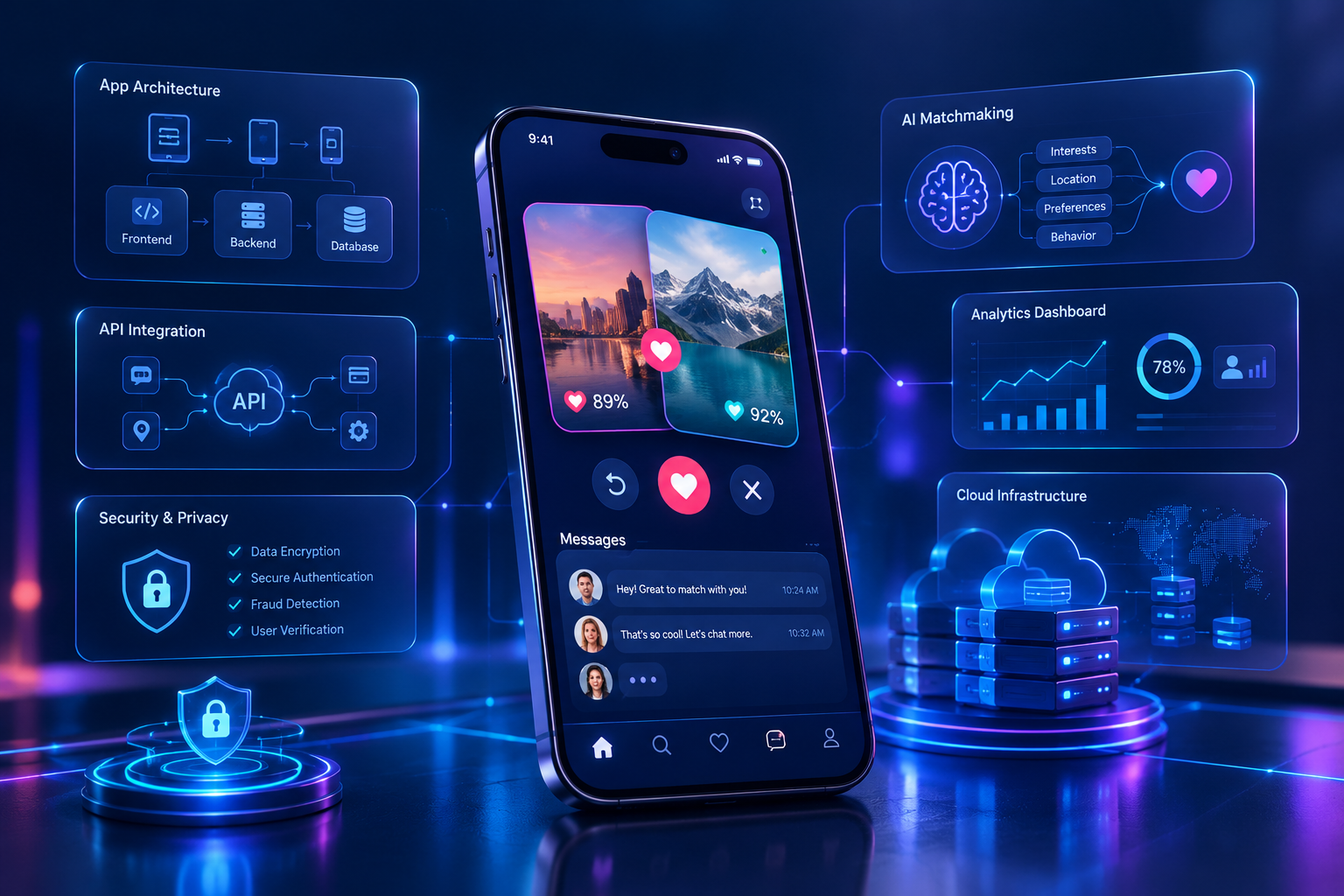
Dating applications combine mobile interfaces, profile management, search, matching, messaging, notifications, and account security. Some platforms also use recommendation systems to help users discover potential connections.
For businesses considering the development of a dating application, several technical components deserve attention.
User Profiles and Preference Management
A dating app needs a reliable way to manage profile information, photographs, interests, preferences, and account settings.
Developers should collect only information necessary for the service and provide clear controls over what users share.
Matching and Recommendation Systems
Matching systems can use declared preferences and other permitted signals to recommend potential connections. These systems should be evaluated for relevance, fairness, reliability, and unintended outcomes.
A recommendation is not proof of compatibility, and product teams should avoid suggesting that an algorithm can guarantee a successful relationship.
Messaging and Notifications
Messaging, push notifications, and account controls help users communicate efficiently. Applications also need tools for reporting abusive behaviour, blocking accounts, and reducing spam.
Security and Data Protection
Dating platforms can handle sensitive personal information. Secure authentication, access controls, encryption, data-retention policies, and incident-response procedures should be considered from the beginning of development.
Privacy should be built into the product rather than treated as an optional addition.
Performance and Scalability
As an application grows, it may need to handle increasing numbers of profiles, searches, messages, and notifications.
A suitable architecture helps maintain performance as user activity changes. Businesses planning a digital product can explore mobile application development services or custom software development to understand the technical considerations involved in building applications around specific requirements.
You can also explore Galaxium Coding's projects and portfolio to learn more about its work.
Final Thoughts
The best dating apps for serious relationships in 2026 are not necessarily the ones with the largest number of profiles or the most premium features. They are the platforms that help you express your intentions, discover compatible people, and communicate comfortably and safely.
Hinge is a strong starting point for people who value detailed profiles and conversation prompts. Bumble offers communication and safety tools, while eHarmony focuses on compatibility-oriented matchmaking. Match, OkCupid, and Coffee Meets Bagel provide alternative ways to explore potential partners. Tinder, POF, HER, and Grindr serve different preferences and communities.
Before committing to a subscription, compare the available features, check whether the platform is active in your location, and review privacy and safety settings. Communicate your expectations honestly and take time to get to know people before making important decisions.
For businesses interested in building secure and scalable digital products, contact Galaxium Coding to discuss software and mobile application development requirements.
Frequently Asked Questions
1. What is the best dating app for serious relationships in 2026?
Hinge is a strong starting point for people who prefer detailed profiles and conversation-led dating. eHarmony, Match, Bumble, and OkCupid are also worth comparing, depending on your preferences and location.
2. Which dating apps are best for long-term relationships?
Hinge, eHarmony, and Match are commonly considered by people exploring long-term relationships. Bumble and OkCupid may also suit users who want to communicate their intentions and preferences clearly. No app can guarantee a lasting relationship.
3. Are dating apps free to use?
Many dating apps offer free registration and basic features. Some filters, additional likes, visibility options, or communication features may require a paid subscription. Check the current terms in your country before subscribing.
4. Which dating app focuses on compatibility?
OkCupid uses compatibility questions and personal preferences, while eHarmony focuses on structured compatibility-oriented matchmaking. Both approaches can help start useful conversations, but neither guarantees that two people will be compatible in a relationship.
5. Is Hinge better than Tinder for serious relationships?
Hinge emphasizes detailed profiles and interactions based on profile prompts. Tinder offers a familiar swipe-based experience and supports a wider range of dating intentions. The better choice depends on your preferences and the active community in your area.
6. Which dating apps offer detailed profiles?
Hinge, Match, OkCupid, and eHarmony offer profile or matching experiences that can help users explore personal information, preferences, or compatibility. The specific details and features available vary by platform and region.
7. Are dating apps safe?
Dating apps provide different safety features, but no platform eliminates every risk. Avoid sending money to online romantic interests, protect sensitive information, use blocking and reporting tools, and arrange first meetings in public places.
8. How can I tell if a dating profile is fake?
Watch for inconsistent information, suspicious links, unusual requests for money, and repeated avoidance of reasonable identity checks. Verification features may help, but a verified profile does not guarantee someone's intentions.
9. Can I use dating apps in Qatar?
Availability and suitability depend on the app, current local conditions, and applicable requirements. Check the official app listing and review privacy, cultural, and safety considerations before registering.
10. What should I look for before paying for a dating app?
Review the free features, local user activity, subscription cost, renewal terms, cancellation policy, privacy controls, and any premium benefits you genuinely need. Try the free version first when available.
11. How do I attract people who want a serious relationship?
Use recent photographs, write an honest bio, communicate your intentions clearly, and start conversations based on shared interests. Take time to understand the other person's expectations before making commitments.
12. Can dating apps guarantee that I will find a partner?
No. Dating apps can help people discover and communicate with potential partners, but relationship outcomes depend on individual preferences, mutual interest, communication, circumstances, and many other factors.